The Day I Broke Into Shibe Park

“I figure I might be able to find it on a night like this when the moon turns everything silver, and the evergreen trees look like they’re covered in tinsel.”

W.P. Kinsella, The Valley of the Schmoon


October 1, 1970 was a sad night.

Not sad in a truly horrible, end-of-the-world sort of way, but in the way you feel when selling a beloved car or moving out of your childhood home. The way it reminds you of a cherished memory, happy and yet tragic at the same time.

You see, that day was the final game at Connie Mack Stadium, better known as Shibe Park to those of us who grew up nearby lovingly remember it.

Boy, that final game sure was a classic. Even though for the past 15 seasons it was no longer our beloved Athletics on the field, we still cherished every inning played at the ‘ol yard. We had all secretly hoped the game would last extra innings, just to drag out the inevitable end just a bit longer – and it did! When the 10th inning began, for just a second it felt like the game, and the stadium, might last forever. Even after Oscar Gamble’s single drove in Tim McCarver to give the Phillies a 2-1 victory, the echoes didn’t dissipate for what seemed like hours. The looting afterward was not surprising, and even with all that chaos and people running out of the park with everything they could carry – seats, bricks, buckets of dirt and grass, it was still a bit funny to us to see someone running off with…a toilet.

A beat up old toilet with green paint splashed on the tank.

Image result for Old Toilet

When the four of us – myself and my childhood friends Charlie, Donnie and Slim – saw this shameless toilet thief, none of us said a word. We just shot a smirk at each other and then proceeded to unbolt seats of our own, the same seats we had occupied for over 40 years, since we first started going to watch the Philadelphia Athletics as kids in the late 1920’s. We were all bummed when the A’s moved to Kansas City at the end of ’54, but we continued to go to Shibe anyway. Not because we were huge fans of the hapless Phillies who’d moved in by then, but we were in love with the ballpark itself. It’s history. It’s feeling. It’s meaning. For it meant something to us, it truly did. That final night reminded me of the first time we visited, or rather broke into, Shibe.

Like most neighborhood kids, we grew up loving baseball and loyally following the A’s. If you lived just a few blocks away you were probably a Phillies fan but where we lived, it was the A’s or nobody. Connie Mack was a God and Shibe Park was his Church. No matter where we were out playing in those summers, our paths always seemed to lead us to the ballpark, like an unseen magnetic force. None of us had attended a real game there yet, but we would always be nearby anyway, soaking up the atmosphere. The iconic four-story tower behind home plate at the corner of Lehigh and 21st, where we knew Mack’s office sat at the pinnacle, was the most important landmark to every eight-year old kid in the area. Sure, we would traipse the few blocks over to the Baker Bowl to see what the Phillies were up to on rare occasion, but it didn’t compare to the vibe at Shibe whatsoever.

One of those summer days in ‘25, Slim earned his nickname, and we earned our stripes.

The A’s were on a western road trip (really the Midwest since no team existed further west of St. Louis in those days), so the neighborhood was quiet and largely empty. We were doing our usual thing, hanging around the park, when Slim, aka Mikey Donatelli, noticed that behind the wooden right field wall near where it joined to the first base grandstands, were some damaged boards. A gap. To the four of us, looking through that hole in the wall out at the empty seats and the vast sea of emerald green grass was like peering through a rip in the veil that separates the earth from heaven. As we noticed there were no security guards nearby, we desperately wanted to get inside the park. Not to mess with or take anything – of course not – but just to experience it firsthand. The problem was, the gap was just too small for us to fit through. Except of course, for Mikey.

We hatched a brilliant plan for him to wiggle through the opening and sprint, hugging the grandstands to minimize his profile, to the first base side concourse and let us in one of the locked grandstand doors. It was almost too easy, even to our youthful minds.

To our amazement, the nefarious scheme worked like a charm. As Mikey slid through the gate and made a beeline to the concourse, we decided his nickname was to be changed from “Teapot” to “Slim.” Nobody really knew where “Teapot” came from anyway, though it was suspected it was given to him by an Aunt after some sort of kitchen mishap. But that’s not important right now. When the door on the 21st street side opened to us, the feeling of euphoria was nearly too much to handle. Instead of doing what most kids would do in that situation – go on the field and run the bases, sit in the dugouts, venture down the tunnel to the clubhouse and secret passages under the stadium – we simply sat. We walked halfway up the third base line, picked four random seats and just sat. And revered. And kept quiet. We were mesmerized.

Before we knew it, nearly an hour had gone by and we didn’t feel too guilty or even apologetic when the good-natured security guard shooed us back out the very door we entered from. Nor were we surprised when our secret gap in the fence was repaired the very next day. But we had accomplished something, we felt, that not only elevated us to grand status in the neighborhood but cemented in us a pure love for a piece of architecture that wouldn’t dissipate. In fact, two years later after much begging and negotiating, all our families agreed to purchase four season tickets, in those very four specific seats. Good thing we did, then, because times got pretty tough a couple years later.

As we were being ushered toward the door, Charlie O’Toole, the quietest of our group despite being part of a boisterous Irish-Italian family was walking several paces behind the rest of us when he spied something. The door to a small storage room at the bottom of the rotunda was left open. Peeking inside, Charlie noticed among the clutter a few buckets of used baseballs in the room. Never one to miss out on a souvenir, he pocketed four of them, one for each of us, to mark the occasion. I still have mine today, and I assume the other guys do too. I often stare at it while it’s perched in its case, along with lots of other A’s memorabilia, and next to the seat I left Shibe with that night. It’s impossible to know the true story of each ball of course, but I think it’s better that way. To me, I believed my ball was once in play, right there on the majestic Shibe Park field, and used by the game’s greats. It was once, perhaps more than once, slugged by Babe Ruth. It was a would-be triple robbed by Tris Speaker. It was slung by Walter Johnson and gracefully fielded by Eddie Collins. I’ll always believe all the above are true when I look at the ball that Charlie confiscated for me. Along with the seat, holding on to pieces of Shibe allow her to exist even though she’s gone.

The storage room, Charlie said, also served as a small bathroom. As he pocketed the baseballs, the splashes of green paint he noticed all over the toilet wouldn’t seem significant to us for another 45 years.


The Mays Malaise

Coincidences happen, of course. But on occasion, some situations can foretell what’s to come. Baseball analysts and sabermetricians have been on the hunt for the Holy Grail metric; that figure which can predict what a player will, or at least very likely do, for years. Where Carl Mays was concerned, predictability was nearly impossible. Actually, it was scary.

The submariner had something of a tumultuous career, and a personality that wasn’t quite favorable among players and coaches in the majors. Moreover, he was a spitballer, and combined with his unique delivery and blazing fastball it made him a formidable, if not dangerous pitcher.

This stigma was strengthened in 1915 during a fiery encounter with Ty Cobb and the Detroit Tigers. Mays, pitching for the Red Sox, repeatedly threw at Cobb each at-bat during a game, prompting Cobb to throw his bat at Mays in the eighth inning. Once things calmed down, Mays responded by plunking Cobb on the wrist (1). For whatever malice he may or may not have pitched with, he appeared to have no fear or shame.

Still with the Red Sox in 1918, Mays and his team were enjoying a fantastic season, one that would end with a World Series Championship over the Chicago Cubs. Mays was the ace of the staff that season, going 21-13 with a 2.21 ERA, tossing 30 complete games and tacking on eight shutouts over 293 innings pitched. Earlier in the season on May 20, an incident occurred which, unbeknownst at the time, would portend an eerie and deadly second act. In the third inning of an 11-1 rout of the Cleveland Indians at Fenway Park, Mays let loose a pitch that drilled the great Tris Speaker right on the head. The extreme nature of this beaning only firmed up the already deplorable M.O. that Mays garnered. Nobody could’ve seen what would happen two years later.

In keeping pace with the high-high’s and low-low’s of his career, later in the 1918 season on August 30, Mays became the only pitcher in Red Sox history to throw two complete game wins in the same day. Both wins were integral in keeping the Red Sox atop the pennant hunt.

The frightening beanball Mays laid on Speaker’s noggin was, in hindsight at least, notoriously prophetic. In 1920, Mays, then pitching for the Yankees, would be the instigator of tragedy. In one of the most infamous moments in baseball history, Mays hit Indians’ shortstop Ray Chapman on the skull, killing him. Mays always vehemently denied throwing at Chapman intentionally, and even went so far as to attempt blame on Chapman for crowding the plate. Two years, two Indians players hit on the head, and one sparkling young player killed. This incident would haunt Mays for the rest of his life.

Chapman’s death ignited a series of rules changes that are still in use today. Beginning shortly after the tragedy, umpires began to insert new baseballs into the game when the one in play became scuffed or too dirty. The spitball and other doctored-up pitches were outlawed, and although it took over thirty years to be fully integrated, batting helmets began to be used.

Mays’ career continued with success, despite a permanently damaged reputation after the Chapman beaning. In 1921, Mays had the best season of his career when he led the league with 27 wins and 336 innings pitched. He helped lead the Yankees into the World Series against the New York Giants but his sterling season was marred amid accusations that he was offered a bribe from gamblers to throw Game 4 of the World Series. As the alleged story goes, Mays’ wife Marjorie signaled her husband from the stands that she had received the bribe money and the pitcher was now in the bag. Mays, who had been dominant up until then, started crossing up his pitch signals and became lackadaisical, allowing the Giants to clobber him and take a lead they would not relinquish (2.) The Giants went on to win that game and eventually the best-of-nine-series, five games to three. Though cleared of any wrongdoing, the rumors of conspiring with gamblers felt like salt in the wound of baseball, with the Black Sox scandal of 1919 being so fresh in everyone’s minds.

Mays would pitch until 1929, ending a 15-year career and all told, his numbers were excellent. He compiled a record of 206-127, with 29 shutouts and a 2.92 ERA. He won 20-plus games five times. Still, he has been left out of the Hall of Fame, despite having career statistics that could make him worthy of the accolade. His ugly reputation, combined with suspicion of throwing a World Series game and Chapman’s death are the likely scapegoats of Mays not being enshrined.

Sources

(1) http://www.thedeadballera.com/prelude.html

(2) “1921: The Yankess, The Giants, & the Battle For Baseball Supremacy In New York:, Lyle Sptatz and Steve Steinberg

https://www.baseball-reference.com/boxes/BOS/BOS191805200.shtml

https://www.baseball-reference.com/teams/BOS/1918.shtml

https://www.baseball-reference.com/postseason/1921_WS.shtml

http://nationalpastime.com/

https://en.wikipedia.org/wiki/Carl_Mays

Angry Attack: Cubs’ visit to Rivals Park in 1920 marred by stabbing

The following is non-edited, curated content from a story I wrote that appeared in the Joliet Herald-News on March 21, 2018. 


Joliet was a happening place nearly a century ago.

With burgeoning local businesses and a strong sense of civic pride, plus the bonus of being a just short train ride to Chicago, “J-Town” was the place to be in a growing suburbia.

Social pastimes were also wildly popular as the roaring twenties began, in which baseball featured prominently. As it still is today, Joliet and the surrounding areas were a hotbed of baseball talent.

The Joliet Rivals Club, founded in 1907, were no strangers to baseball, having fielded local teams dating back to their early years. Even the Chicago Cubs paid a visit in the fall of 1920 to play against the Joliet Rivals, a semi-pro team named after the very park they played at. Sources also refer to the team by their former name, the Rivneas, a combined name of the Rivals and Northeastern A.C.’s of Joliet, who’s World War I-era roster was comprised of several former major and minor leaguers.

That the Rivals-Cubs game itself was played was not surprising, as in those days most major league clubs scheduled exhibitions against local semi-pro or college teams on their days off. These unofficial games were a means for the team to have real game action instead of a practice, and to give local teams and their fans a chance to see big league stars in action up close.

One such contest took place here in Joliet, on Thursday, September 30, 1920. The circumstances that surrounded this game however, have made it a rather infamous, if forgotten, episode of Joliet folklore.

With the Cubs en route, the buildup to the game was strongly publicized, with multiple articles appearing the week of the game in the Joliet Evening Herald News. An overflow crowd of more than 5,000 paid spectators (roughly 13% of Joliet’s population at the time), turned out on game day, more than twice filling the 2,000-seat capacity of Rivals Park (formerly Theiler’s Park before the Rivals Club purchased the property in 1919), on the corner of Broadway and Russell streets. Hundreds more crowded along the streets beyond the outfield, battling for the slightest vantage point. A parade to the ballpark from the downtown Elks Club where the Cubs were staying got the festivities underway, and once at the park fans shelled out 25 cents for a grandstand ticket, while the big spenders handed over a whopping $1 for a reserved box seat. Joliet mayor William Barber added to the fanfare by tossing the ceremonial first pitch on that autumn afternoon.

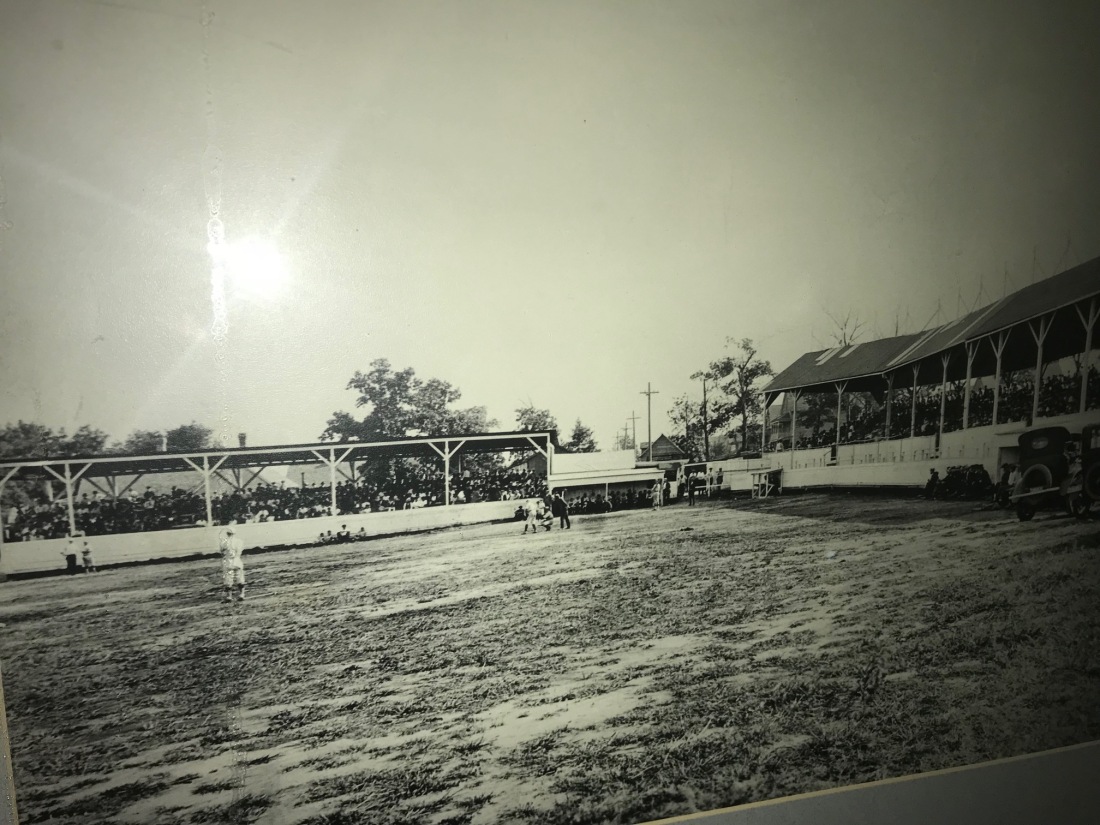
IMG_1291
Rivals Park in Joliet, IL circa 1920.

Joliet native Abraham Lincoln “Sweetbreads” Bailey took the mound for the Cubs in what was one of his only six career starts. Bailey, primarily a relief pitcher in his three-year major league career, held a 4 to 1 lead in the fifth inning when the Rivneas mounted a furious comeback that the Cubs couldn’t answer. Much to the delight of the overflow crowd, the Joliet club emerged victorious by a final score of 5-4. This of course was a tremendous triumph for the hometown team to knock off the Cubs, exhibition game or not. But the excitement didn’t end there.

Immediately following the game, as the Cubs players walked to waiting cabs to be taken back to their hotel, a fan emerged from the grandstand and waylaid Cubs third baseman Buck Herzog, igniting a fierce fight. During the scuffle, a friend of the instigating Jolietan brandished a knife and slashed Herzog across the hand and leg. Seeing the brawl unfold, two Joliet players, Frank Murphy and Nick Carter stepped in to subdue the attackers, ending the melee. Herzog returned to his hotel, no worse for wear except for what was later called a “slight scratch” on his hand.

As the story goes, the fan accused Herzog of being “…one of those crooked Chicago ballplayers” before launching his assault. This is significant when considering the motive behind the attack. It’s a longshot, but there is the possibility that the fan, if only a casual one, got his Chicago teams confused and was mistakenly referring to Buck Herzog as Buck Weaver, who just that very week was suspended along with seven of his teammates by Charles Comiskey amid accusations of throwing the 1919 World Series. This misidentified burst of violence then would be doubly ignorant if so, since Weaver’s banishment was highly unjust itself (though that’s another story altogether). But in an era long before the internet or even player names and numbers on their jerseys, it is not beyond the realm of possibility that the attacker assumed this third basemen nicknamed “Buck” from Chicago was in fact the other third baseman nicknamed “Buck” from Chicago.

On the contrary, it is much more likely that the attacker was in fact referring to the well-known, open accusations Buck Herzog received just a few weeks earlier for conspiring to throw a game on August 31st against the Phillies at Wrigley Field.

“I’m sorry it occurred,” Herzog said, “but I couldn’t resist punching that fellow when he called me a crook.”

Although gambling on, and even throwing games had been occurring for decades, the breaking news of the Black Sox scandal forced the game of baseball at all levels to take a long, hard look at itself as it faced an uncertain future. If an outside force such as gambling could infiltrate baseball, heralded as the cleanest of games, then anyone accused of conspiring against the game was met with a multitude of harsh reactions. We will likely never know the full truth of the reason behind the attack on Herzog at Rivals Park that day, but it is interesting to speculate on both possibilities nonetheless.

Baseball continued as usual at Rivals Park until 1934, when the ballpark was redesigned to accommodate professional softball and later Little League baseball on the site. In doing so, Joliet’s first illuminated softball diamond was conceived. In recent decades, the Rivals Club has shifted focus away from organized sports, and now shares the lot with Haunted Trails amusement park. Yet the historic club remains an important, active participant in an ever-changing, but still baseball-rich Joliet, much as it did in 1907.

And certainly as it did when the Cubs came to town.

Special thanks and photo credit to Richard Rivera, Joliet Rivals Club President.


Sources:

Joliet Rivals Club, A Centennial Celebration: 1907-2007 by Marianne Wolf

Joliet Evening Herald News, September 26-Oct 1, 1920, microfilm at the Joliet Public Library

Chicago Daily Tribune, Oct 1, 1920

365 Oddball Days in Chicago Cubs History by John Snyder

https://cdnc.ucr.edu/cgi-bin/cdnc?a=d&d=MT19201001.2.25


A Lucky Bounce (or Three): Washington’s Wild World Series Win.

Seven games, four decided by one run, and two going to extra innings. When all was said and done, the 1924 World Series was an absolute classic.

And maybe one of the strangest, too. Particularly Game 7.

John McGraw led his powerhouse New York Giants into Griffith Stadium on the 10th of October, hoping to steal the series from the hometown Washington Senators and secure his third world championship in four years. The Senators’ player-manager Bucky Harris, along with ace and Hall of Famer Walter Johnson – and perhaps a bit of divine intervention – had other plans, however.

To this point, the series was a seesaw battle, with each team winning alternate games, sometimes in sloppy fashion. Odder still, was that the great Walter Johnson had pitched far below his potential and had taken losses in Games 1 and 5. Running out of arms, options and luck, Harris was in need of a little help if his Washington club was going to get their rings.

Washington starter Curly Ogden took the hill but was pulled after facing just two batters and retiring one, as he gave way to George Mogridge. Apparently, Harris started the righty Ogden so that McGraw would be forced to load his lineup with left-handed hitters who would then have to face the lefty Mogridge unprepared. The ploy worked, as Mogridge would be solid over the next 4 2/3, allowing one earned run and scattering four hits. Firpo Marberry came on in relief in the sixth, but after two unearned runs swiftly crossed the plate the Senators found themselves in a 3-1 deficit entering the late innings. Marberry shut down the Giants in the seventh and eighth, all while the Giants starting pitcher Virgil Barnes was cruising, only allowing one run on a Bucky Harris homer in the fourth.

With one out in the bottom of the eighth, Harris inserted pinch hitter Nemo Liebold, who had previously appeared in both the 1917 and 1919 World Series’ with the White Sox. Liebold lashed a double, followed by a single by catcher Muddy Ruel. Bennie Tate came in to pinch hit for Marberry, his job done for the day, and walked to load the bases. Suddenly Barnes’ sterling efforts were coming to a screeching halt. Harris stepped to the plate and got the extra help he sorely needed, as a seemingly routine grounder to third basemen Freddie Lindstrom took a wild hop over his head, plating two runs and tying the game. The 31,667 at Griffith Stadium tore in to a frenzy, with new life late in the contest.

With few choices on remaining arms, Harris called upon Johnson to step to the bump in the ninth. Despite his lackluster performances earlier in the series, “The Big Train” began to completely shut the Giants down from the jump. After failing to score in the bottom frame, Game 7 was headed to extras, and Johnson continued to dismantle Giants’ batsmen in the 10th, 11th and 12th innings as well. It was then in the bottom of the 12th, where a little more assistance from the ether was made available. With one out, Giants pitcher Jack Bentley got Ruel to loop a foul pop to catcher Hank Gowdy, who unfortunately stumbled over his own discarded mask and was unable to make the play. On the next pitch, Ruel ripped a double to left, bringing up Johnson. The Big Train rapped a grounder to Lindstrom’s left, where he was unable to handle another bad hop, putting runners on first and second with one out. Center fielder Earl McNeely stepped to the box and the standing room only crowd at the ‘Griff was hoping for one more miraculous bounce. Their prayers were answered, as McNeely found a hole on the left side by way of yet another unlucky hop, plating Ruel for the series’ winning run. Sometimes, you just need the ball to bounce your way a time or two…or three. After the game, losing pitcher Bentley summed up the bizarre afternoon:

“That was one of the strangest games I ever played in. With one out, Hank Gowdy did a sun dance on Ruel’s pop foul and stepped into his mask and dropped the ball. Ruel doubled and then there was an error at short, then McNeely hit that grounder. That was a helluva way to lose a World Series.”

The championship was the first and only one for the Senators in Washington. Decades later, the franchise would move to Minnesota, where the Twins would grab World Series titles in 1987 and 1991. The Senators would win the American League pennant again the following year in 1925, but would lose to the Pittsburgh Pirates. Yet for that one magical day in ’24,  Harris, Johnson, and a few wild bounces would ensure that Washington would reach baseball’s pinnacle.

‘Tis a weird game, folks.

Checkout some amazing video highlights of the game: https://www.youtube.com/watch?v=b2AN9IDDLqg

Sources: http://bleacherreport.com/articles/1386103-washington-nationals-remembering-the-1924-world-series

https://www.baseball-reference.com/boxes/WS1/WS1192410100.shtml

https://en.wikipedia.org/wiki/Curly_Ogden

Remembering Old Hoss

Today, on the 121st anniversary of his death, we’d like to offer a tip ‘o the cap to one of the greatest pitchers the game will ever see, and the namesake for this very website.

This dapper gent not only holds the unbreakable major league record for wins in a season with 59 in 1884 (and is also tied for 5th with 48 wins in 1883), but he also taught endless ensuing generations the art of donning the competitive mustache, as well as being the first known human daring enough to flip the bird at the camera.

Fare well, sir.

An interview with baseball historian and author, Gary Livacari

Today we’re honored to spend a few moments with baseball historian, author, editor of the greatest page in the history of facebook, and lifelong Chicago native Gary Livacari! In addition to contributing content to SABR‘s great BioProject and several books, Gary has just published the fantastic Memorable World Series Moments, a collection of great stories from various fall classics of yesteryear, going all the way back to 1909. In this book, Gary compiles all the interesting, humorous and strange tales from some of the greatest World Series’ and their heroes of past eras with a reverence and boyish fascination that we, as baseball junkies, can all relate to.

GaryBook

Gary, thanks for joining us today!

My pleasure!

So tell us, how did the idea of writing this new book come about?

I’ve always enjoyed writing, especially about baseball history, which is a subject I love and one that I happen to know a little bit about. I’ve been a SABR member for many years and have done numerous biographies for the SABR BioProject. For the longest time, I had been saying to myself it would be nice if I could combine my love of writing with my love of baseball history. I would often say to myself that “I have a book inside me somewhere, but I just don’t know what it is yet.”

That was the situation about four years ago when Ron Bolton asked me to join him as an editor of the Old-Time Baseball Photos facebook page. I started writing two or three short essays per week on different topics related to baseball history. It proved to be a great outlet for me, writing about subjects I enjoy. One of the continuing topics I wrote about over the years was “Famous World Series Incidents.” As time went on, I realized that I had written over 25 essays on different World Series’. Then the light bulb  went off: Why not compile all these essays into a book? There was my book, sitting right in front of my nose the whole time! So that became the genesis of the book, Memorable World Series Moments. 

Did you self-publish, or go through a publishing company?

I self-published. Amazon makes self-publishing, both e-book and paperback, very easy if you’re somewhat computer and tech-savvy. I had the entire project up and running and finished within six weeks, and it cost me very little. There’s a very limited audience for a niche subject matter like mine, so finding a conventional publisher for my idea would’ve been out of the question. So six weeks after coming up with the idea, I became a published author!

Why did you choose that particular publishing route so quickly?

One of my friends gave me the book Publish and Profit by Mike Koenigs. The theme of the book is how easy it is to self-publish, and how becoming a published author adds immensely to your credibility. It establishes you as an “expert” while opening up numerous doors (speaking engagements, etc.) Plus, it’s enormously self-gratifying. I suddenly had people asking me for my autograph which I humorously refer to as my “15 minutes of fame.”

What were the main differences in writing content for the book compared to your website, Baseball History Comes Alive! and the facebook page, Old-Time Baseball Photos?

Very little difference because my book is a compilation of short essays I had written and posted on my site and facebook page. I just did some editing prior to publishing the book. Plus I added to the book something I call Gary’s Handy-Dandy World Series Reference Guide. This is a compilation of World Series records and other bits of baseball trivia related to the World Series I had been collecting over the years. I thought this would be a good place to publish it.

Do you have a favorite chapter or story you wrote, and why?

My favorite chapters are the ones about famous World Series “goats” like Fred Snodgrass in 1912, Heine Zimmerman in 1917, Freddie Lindstrom in 1924, Ernie Lombardi in 1940, and Mickey Owen in 1941. For some reason, I had always been interested in these types of stories. Even as a little kid I had heard of these incidents, and always felt some sadness for these players who were blamed for losing the World Series. With just a little research, I found that almost invariably they were blamed unjustly. So I was glad to have the opportunity to write about them, hoping to do my little bit to set the historical record straight.

What was your biggest challenge and biggest reward from writing this book?

The biggest challenge was learning how to format the manuscript for publication completely by myself after I had finished the writing. I wanted to prove to myself that I was capable of solving all the technical issues that arose, so that it would be truly self-published. I found a couple e-books on the internet on self-publishing, and, to my amazement, I was able to complete the project without too many stumbling blocks. The biggest reward has been the positive feedback I’ve received. Most of the people who bought the book seem to genuinely like it!

What is it about baseball history in general that you find so appealing and interesting?

That’s an interesting question. I’ve been a Cubs fan since 1955 when I was 5 years old. I have fond memories of sitting on my Grandfather’s lap watching Cubs Sunday doubleheaders on our old black-and-white TV after Sunday dinner. I’ve been a baseball fan ever since. Those were wonderful old days, so there’s definitely an element of nostalgia for the past locked into my psyche. I’ve often said if you ask any baseball fan how he became a fan, you’ll almost always find a story similar to mine.

There’s just something about the “old days” of baseball that I’ve always found fascinating. I wish I could find the words to express this fascination. I think it’s basically an intangible, almost subconscious thing. I know it’s there, but I can’t really explain it. I’ve always been an avid student of American history (I’m somewhat of an authority on the Civil War), so perhaps that has something to do with it. In studying baseball’s past you can’t help but learn a lot about America’s past. Baseball is just intertwined into America’s history. But it’s deeper than that, part of one’s “makeup.”

Any plans for publishing more books in the future?

You bet! Now that I’ve got the first one successfully under my belt, I’m constantly tossing ideas around in my mind. And I wouldn’t mind doing something with Mr. Kevin Trusty!

Neither would I! I think we could come up with a fascinating project(s) and look forward to seeing what’s on the horizon there. Thanks for your time Gary, and congratulations on a great book! 

Thank you!


Buy Memorable World Series Moments here

Visit Baseball History Comes Alive!

Check out Old-Time Baseball Photos on Facebook!

The Greatest Game Ruth Ever Pitched

In the years before he became the near-mythical Yankees’ slugger he is known for, Babe Ruth was a terrific pitcher for the Boston Red Sox. In 1916, he was tops of the World Series champion’s staff, compiling a 23-12 record with an American League leading 1.75 ERA and 23 complete games in 323 innings pitched.

Arguably his pinnacle, if overlooked, performance was in Game Two of the 1916 World Series.

Image result for babe ruth 1916 world series

Playing at nearby Braves Field in Boston to accommodate a much larger crowd than could be squeezed into Fenway Park, the Red Sox entered Game Two with a 1-0 series lead over the Brooklyn Robins (later the Dodgers.) Ruth would take the bump against Brooklyn’s Sherry Smith, a solid hurler who went 14-10 with a 2.34 ERA on the season, in a battle of southpaws. What transpired was a tremendous 14-inning duel that left fans captivated as darkness descended on the then brand new Boston ballpark and certified Ruth as a true ace.

With two outs in the first frame, Brooklyn’s Hi Myers launched a ball off Ruth to right center that got past both Harry Hooper and Tilly Walker. With the two outfielders unable to corral the bounce off the wall, Myers chugged all the way around the bases for an inside the park home run. Neither team scored in the second, but the Red Sox were able to tie it up in the third when Ruth’s groundout scored Deacon Scott, who led off the inning with a triple.

For the next several innings both teams threatened, but gallant pitching by both Ruth and Smith and excellent defense held serve as neither team could flash a run across the dish. With the score still tied 1-1, the Red Sox’ Hal Janvrin led off the bottom of the ninth with a double. Pinch hitter Jimmy Walsh reached on an error, and Boston enjoyed runners at first and third with no outs. A fly ball from Dick Hoblitzell to center field promised to be the game-winning sacrifice fly, but Brooklyn’s Hi Myers, contributing from both sides of the plate, pegged Janvrin at home to preserve the tie. Larry Gardner would then foul out to end the inning and send Game Two to extras.

As was the case all day, both teams threatened in each of the extra innings but couldn’t capitalize. Daylight was fading now, and the game would’ve been ruled a tie if they couldn’t finish one way or another, soon. Brooklyn, trying to seize another opportunity, had their last best chance in the top of the 13th. With a runner on second and no outs, Sherry Smith, who was still on the mound, looped a liner to left field. Duffy Lewis, an outstanding defensive player in his own right, took a page from the Tris Speaker handbook when he tore in from deep left to make a sensational catch, saving a run and perhaps, the game.

Smith set Boston down in order in the 13th, and Ruth followed suit to Brooklyn in the 14th. It was now time for some classic deadball-era smallball by the Sox.

Hoblitzell led off with a walk and Lewis sacrificed him to second. Sox skipper Bill Carrigan inserted Mike McNally to run for Hoblitzell, and Del Gainer to pinch hit for the struggling Larry Gardner. The gamble worked, as Gainer roped a single to left field and McNally beat a strong throw by Zack Wheat to the plate, giving Boston the 2-1 victory and a two games to none lead in the series. They would go on to win in five games for their second World Championship in a row.

Not lost on the thrilling finale to this game was the incredible pitching by both Sherry Smith and the victorious Babe Ruth, both going the distance. Smith’s final line tallied 13.1 innings, scattering seven hits and two earned runs while walking six and striking out two. Ruth was even better, going the full 14 innings, allowing only six hits and one run, with four strikeouts and three free passes. The win not only put the Red Sox in the drivers seat to clinch the series, but it cemented Ruth as a big-game pitcher who really put an exclamation point on his stellar regular season. Two years later, Ruth would twirl another gem in the World Series, shutting out the Cubs 1-0 in Game One. As sterling as that was, his Game Two sensation against Brooklyn may have been better.

Ruth would enjoy a couple more strong seasons on the mound for the Red Sox, but by 1918 his bat really began to emerge, and 1919 saw him achieve true slugger status. Prior to the 1920 season he was sold to the New York Yankees, helping them create a dynasty and launching Ruth into his legendary status thereafter.

Yet long before having his likeness carved into the Mount Rushmore of baseball legends, the stocky kid from Baltimore was quite the sensational southpaw on the hill.

Sources: Braves Field: Memorable Moments at Boston’s Lost Diamond. Howlin & Brady, 2015.

https://www.baseball-reference.com/boxes/BOS/BOS191610090.shtml

https://www.baseball-reference.com/players/r/ruthba01.shtml

https://www.baseball-reference.com/teams/BOS/1916.shtml

Photo Credit: https://en.wikipedia.org/wiki/Curse_of_the_Bambino

Some History Is Hard to Repeat

If you ask Cubs fans to describe the 2017 season, many will say, “disappointing.” Perhaps that’s because of the way the season ended, in a completely flat offensive effort in the NLCS against the Los Angeles Dodgers. Maybe it’s also because something just looked off about this team all year, and they never fully clicked for whatever reason.

The tunnel vision vantage point may feel somewhat bleak, but stepping back, the panoramic view is pretty damn bright.

For if this season was “disappointing” and yet still yielded a 92-win Central Division title and a playoff run to the NLCS for the third straight year, that’s something to be pretty content with given Cubs history.

There’s that word again: History. As in, the past. As in, last year is over. As in, I think that’s where some of the fans’ disdain for how this season went down began. Here, then, is a good time to remember one of the chief lessons in baseball: No team, game, or season is ever the same.

The Plan worked. 2016 was magical. Not just because of the 108-year World Series drought ending, but in the way it happened. It was as close to an ideal season as any team could have. Literally a dream come true for long-suffering Cubs fans. In addition to having the deepest and most talented team in all of baseball, the Cubs enjoyed a red hot start that carried throughout the whole season save for a rough stretch just before the All-Star break. More importantly, this was a team with the rarity of near complete health all season save for Kyle Schwarber, who’s absence before coming back to be one of the World Series heroes was perfectly filled by the depth and flexibility of his teammates. Throw in the NL MVP, two Gold Glove winners in your starting nine, and two of the five starting pitchers in your rotation finishing second and third in Cy Young Award voting, and you have a recipe for a Championship season. And so it was done. (Not without three exciting series’ in the playoffs capped off by the greatest Game Seven of all time of course, but that’s another story altogether.)

2016 was as close to perfect as it gets. 2017 was not. And that’s ok.

For whatever reason, this year’s team stumbled early and often. The starting pitching wasn’t nearly as sharp, many bats slumped at once, there was a rash of injuries to several key players who missed significant time, the bullpen didn’t always hold serve and the platinum defense of 2016 regressed significantly. It took until after the All Star break for something to finally set right with this group, when they emerged from 5.5 games back on July 15 to win the division at the end of September. But still, something just didn’t look right.

There were notable offensive quirks by many players throughout the year. Kris Bryant hit .295 with 29 homers but only drove in 74 runs. Kyle Schwarber knocked out 30, but only hit .211 and that was due to a surge after coming back from the minors where he was sent after a couple months of living far below the Mendoza line. Addison Russell wasn’t the same, missed time with an injury and didn’t duplicate his production from the year before. Stalwart veteran Ben Zobrist had his struggles, and battled his health all season. Willson Contreras was having a monster year before being sidelined on the DL. Jason Heyward, under much scrutiny after a dreadful ’16, actually managed to hit 30 points higher and improved across the board in every offensive category, and yet still didn’t really pass the eye test and was benched for the second straight year in the playoffs for lack of production. Not that it was just him though, the entire team went flat against the Dodgers, losing four games to one and scoring only eight runs in the five games, all on home runs. The book was closed on 2017 with a major ebb, after not a lot of flow.

As I sit here writing this and listening to the excellent (and in context, very atmospheric) Pearl Jam – Let’s Play Two: Live At Wrigley Field record, I perhaps should be disappointed in the way this season ended, but I’m really not. In fact, I’m encouraged. For a team that battled through a lot of injuries, inconsistent play, individual struggles, and balls-to-the-wall competition in the division from the Milwaukee Brewers and St. Louis Cardinals (and earlier, the Pittsburgh Pirates), and still emerge with a third straight trip to the NLCS…well, its something I never thought I’d see in my lifetime. So really, 2017 wasn’t all that bad.

Granted, I’d be furious right now had 2016 not happened. In fact, I might start to believe that it never would happen.

In some ways, 2017 sort of felt like playing on house money. Sure I was hoping for a repeat, but baseball is the hardest sport to land a consecutive championship, so expecting one was a little unrealistic, even with the bulk of the 2016 team still here. The good thing however, was there was no pressure anymore. For all of the erroneous Curse believers, it was gone. Mission accomplished, and now we as fans could focus on the present and no longer the forlorn barrage of “what ifs” and “there’s always next year’s.” Cubs fans expect to win now, and make deep playoff runs, and for the third straight year, that’s what happened. Now this team can gear up for 2018 with a renewed focus, new faces on the roster and on the coaching staff (following the firing of pitching coach Chris Bosio yesterday), and perhaps a sense of unfinished business too.

Just remember, no team, game, or season is ever the same.

Four months until Spring Training…

Sources: https://www.baseball-reference.com/teams/CHC/2017.shtml

https://www.baseball-reference.com/teams/CHC/2016.shtml

The Curious Case of Gentleman George

George Sisler is a name seldom brought up when discussing the greatest ballplayers of all time. Given his career accolades and Hall of Fame status, that’s an injustice.

“Gentleman George”, also nicknamed “Gorgeous George”, was unquestionably the greatest player in St. Louis Browns history, and one of the games first truly elite first basemen. A quantifiable five-tool player, Sisler would play 12 of his 15 MLB seasons with the Browns, ending with a brief cup of coffee in Washington before finishing his career playing for three seasons with the Boston Braves. In that time, Sisler amassed a lifetime batting average of .340, good for 17th all time. Within that span, he would enjoy a mammoth 1920 campaign in which he hit .407 with 257 hits, a record that would last for 84 years.

As if that wasn’t enough, in 1922, Gentleman George would hit a whopping .420, while leading the league in hits, triples, stolen bases and runs scored. For his career, Sisler hit over .300 in 13 of his 15 seasons, over .350 five times, and over .400 twice. His offensive prowess, along with his base stealing ability and defensive wizardry that garnered him much comparison to the great Hal Chase, earned Sisler a rightful place on the stage at the inaugural induction ceremony in Cooperstown in 1939.

But like some other stars that rose through the deadball era, Gentleman George began his big league life as a pitcher. Albeit a short lived stint on the bump, Sisler did enjoy one or two grand accomplishments.

After graduating with a degree in mechanical engineering from the University of Michigan in 1915 (an extremely rare occurrence for ballplayers in that era), Sisler joined Branch Rickey’s Browns staff and posted a 4-4 mark with a 2.85 ERA in 15 games, a very strong body of work for a rookie on a second tier team. The highlight of those, and one that Sisler himself referred to as his greatest thrill in baseball (1), was a 2-1 complete game victory in which he out-dueled the great Walter Johnson. The game, in which George limited the Senators to six hits while striking out three, effectively was saved in the eighth inning by perfect execution of the infamous hidden ball trick. Ray Morgan opened the Senators’ eighth reaching on an error by shortstop Doc Lavin. Skipper Clark Griffith inserted Horace Milan as a pinch runner, who was then sacrificed over to second. On the bunt, Browns second baseman Del Pratt covered first, and after securing the putout, quickly tucked the ball under his right arm, unseen by everyone except Sisler. Moving about the hill in faux-preparedness to pitch to the next batter, Milan began his leadoff from second, when Pratt dove toward him with the ball. Umpire Billy Evans ruled the out and the Washington rally was stopped. Sisler would then finish them off in the ninth for the win.

Shortly thereafter, Sisler’s bat and glove were proving more valuable than his pitching arm, and so a few random appearances on the bump notwithstanding, he would be an every day position player instead, a path that would end in the Hall of Fame.

A year later however, in his second-to-last career start, Sisler would ironically again go up against Walter Johnson. On September 17, 1916, the two would square off at Sportsman’s Park in St. Louis, and again it would be Gentleman George with the upper hand, shutting out Johnson and the Senators 1-0. Sisler would go the distance, allowing six hits and striking out six for the final victory of his pitching career.

In 111 career innings, Sisler would run up a 5-6 total record, with an ERA of 2.35 and a 1.2 WHIP. While not staggering, and certainly nowhere near the echelons of his offensive numbers, this snapshot proves that he was more than capable of being an effective pitcher.

Due to often being on second division teams and having never played in a World Series, George Sisler is often overlooked and rarely discussed. While his Hall of Fame numbers as a first baseman are forever impressive, he did enjoy a few shining moments as a hurler as well.

Sources:  https://books.google.com/books?id=jlDWBgAAQBAJ&pg=PA70&lpg=PA70&dq=Browns+Senators+Hidden+Ball+Trick+1915&source=bl&ots=dGdDK-vRMi&sig=7uIqRXW5p59q65bUmxwNM5zdCRo&hl=en&sa=X&ved=0ahUKEwi1sYOTr6zWAhWL64MKHWQeAwIQ6AEIJjAA#v=onepage&q=Browns%20Senators%20Hidden%20Ball%20Trick%201915&f=false

https://www.baseball-reference.com/players/s/sislege01.shtml

https://www.baseball-reference.com/boxes/SLA/SLA191508290.shtml

http://baseballhall.org/hall-of-famers/past-inductions/1936-1939

http://baseballhall.org/hof/sisler-george

(1) https://sabr.org/bioproj/person/f67a9d5c

Rare Thievery For Shoeless Joe In Cleveland

Joseph Jefferson “Shoeless Joe” Jackson had many accolades in his 13-year MLB career.

His baseball life, although lengthy by deadball-era standards, was nonetheless sadly shortened for his role in throwing the World Series in 1919. Still, Jackson amassed a lofty .356 lifetime batting average, having never hit below .308 in any full-time season, a truly remarkable feat.

1912 was no different, really, in terms of being remarkable. Yet amid all the sensations Jackson would showcase before and after this season, one gem of a game is often overlooked.

Jackson had a fantastic .395/.458/.579 slash line for the 1912 season, to go along with 121 runs scored, nearly twice as much as the next highest player for the 5th place Cleveland Naps (Indians.) He would also swipe 35 bases that year to easily lead the team. On August 11th, in an 8-3 victory at League Park over the visiting New York Highlanders (Yankees), Jackson would take four bases and score twice in the game. That he totaled up those numbers is not surprising, but how he did it, is.

In the first inning, Jackson would keep his name in the discussion with the great Ty Cobb as being one of the few who could confidently steal home successfully. But Jackson wasn’t done yet. In the seventh, Shoeless Joe would achieve the rare stolen base cycle, swapping second, third and then home, in succession, in the same inning. At the time, Jackson was just the fifth player in MLB history to steal home twice in the same game, and even today he remains just one of eleven players ever to accomplish the sterling feat. That he did so while also stealing all three bases in the same inning makes this event stand out.

No player has stolen home twice in the same game since Vic Power pulled it off on August 14, 1958, ironically also while playing for the Indians, at home, and 46 years nearly to the day since Jackson’s marvel.

Image result for Shoeless Joe 1912

Ty Cobb, Shoeless Joe Jackson, Sam Crawford in 1912

While only eleven players have stolen home twice in the same game, swapping all three bases in the same inning is essentially equally as rare. To date, stealing all three bases in the same inning has happened just 50 times in baseball history. The most recent occurrence was by Dee Gordon on July 1, 2011 while playing for the Dodgers against the Angels in Anaheim. Pete Rose also did it in 1980, but before that nobody had done so since Harvey Kendrick in 1928. Some players just breathe rarefied air, even for one inning.

Nobody would ever consider stealing home twice in a game, or swapping all three bags in the same inning easy or commonplace, but don’t say that to Ty Cobb or Honus Wagner, as each man had a stolen base cycle in the same inning an astonishing four times in their careers. But for Jackson, stealing home twice and capturing all three bags in the same inning, both in the same game, was a phenomenal accomplishment.

Sources: http://www.baseball-almanac.com/feats/stealing_second_third_home.shtml

https://www.baseball-fever.com/forum/general-baseball/trivia/80231-i-stole-home-twice

https://www.baseball-reference.com/teams/CLE/1912.shtml

Photo Credit:

https://en.wikipedia.org/wiki/Shoeless_Joe_Jackson