Howdy, folks! Excited to announce that my new novel, Farlight is now available in paperback (eBook coming soon) on Amazon!
Set in 1914 against the backdrop of sweeping cornfields and dusty towns, Farlight combines supernatural mystery, magical realism, comedy and serious baseball drama in a pacey story about our protagonist chasing his dream of playing in the Major Leagues while navigating who – or what – stands in his way.
I had a great time writing this one. Check it out below and feel free to leave a review!
Howdy, folks! Been a minute (again) since my last update here, and for that I apologize.
But I do have an exciting update. Edits are wrapping up as we speak and my next book, Farlight, will be set for release soon. Here is the official synopsis from the back cover:
BASEBALL IS WEIRD
Western Illinois, 1914.
In the heart of the Corn Belt, farming is life, and baseball is the secular religion.
Bright-eyed Johnny Jennings arrives in the tiny town of Thornville with one goal: play well enough to get a shot at the majors. But the moment he steps off the train, something begins to feel…wrong.
Without so much as a friendly welcome, Johnny must juggle life on a windswept old farm, with cold-hearted, hard-drinking teammates and a wrathful curmudgeon of a manager. The long season leads him down a thorny path to the edge of the very spotlight he needs to punch his ticket to the big show.
But something else lurks on the dusky horizon: an unearthly presence that beckons Johnny’s team to a final game in a suspicious, illusive ballpark with more than just the score on the line.
It’s a comedy of errors as magical realism, supernatural mystery and heart-pounding baseball action take to the field in a novel from the author of Beyond Silence and Light, (Not) Just Another Ballgame, and The Mournful Threads.
I certainly didn’t expect about five years to pass between posting. But, fulltime work, a lot of life stuff, and other projects have taken center stage. Mostly, I’ve been posting on my other site, tatteredpage.com, (though not posting nearly enough there, either.)
The Mournful Threads came out in the fall of 2024, and since then I’ve been at work on my next project, titled Beneath the Farlight Sky.
The story is set in 1914, where Johnny Jennings, a 21-year-old first baseman, joins his new semi-pro team in Thornville, Illinois with the hopes of making it to the Major Leagues one day soon. He just needs his shot. But he soon discovers his new team, the small farming town he lives in and his curmudgeon of a manager are not what they were cracked up to be. Everyone on the hard-working, heavy-drinking team is rude and off-putting, and tightlipped about a huge game at the end of the season against a team from a neighboring town. It would seem like your standard small town rivalry game, except for one thing: the town doesn’t exist.
Johnny becomes a key part to the most successful season Thornville has ever had, but the final game looms ahead, where something even stranger than the game of baseball itself is at play.
The manuscript is finished as of today, and hoping to get it out later this spring/summer. Stay tuned!
The inaugural Field of Dreams Game was simply a success. And it succeeded because it was simple.
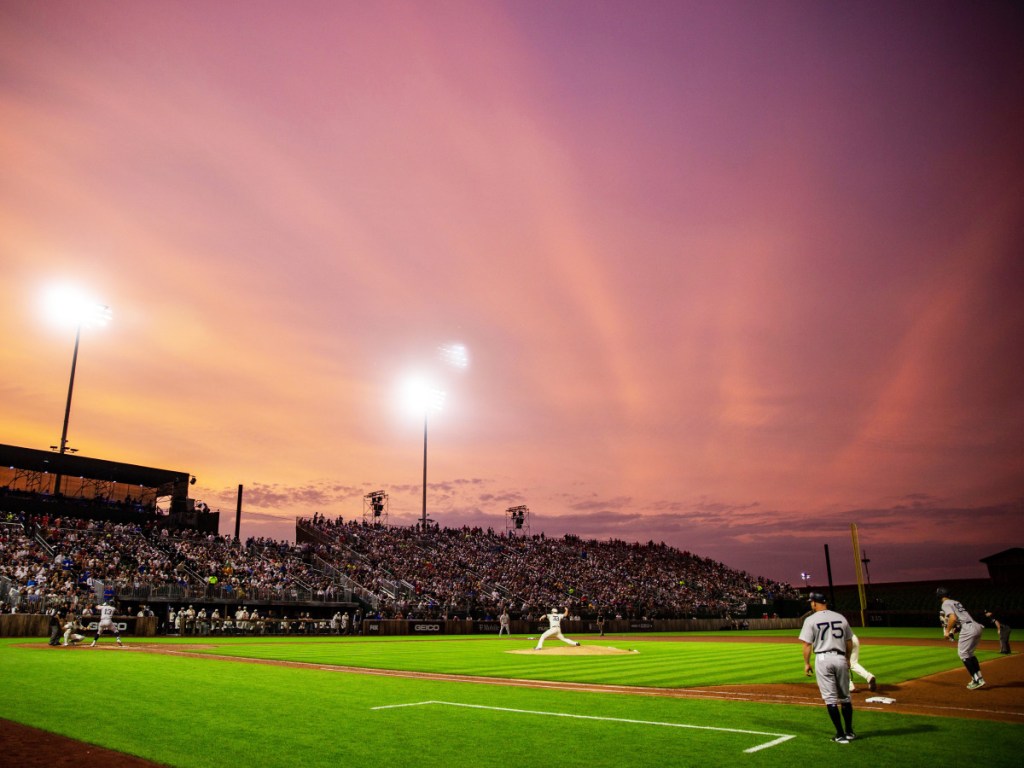
The newly built stadium was unsurprisingly packed (despite the astronomical ticket prices), and the whole rural setting – coveted movie site or not – looked amazing. Mother Nature also dished out a key assist with absolutely idyllic weather, complete with a gorgeous Iowan sunset.
FOX Sports delivered it all with a sterling production that was neither overblown nor underwrought. It was just right. In fact, it may have been one of the smoothest and best-produced ballgames you’ll ever see, again in part because of it’s scaled-back simplicity.
Then there was the game itself, which was outstanding.
Two classic franchises in awesome retro-styled, though with a modern twist, uniforms engaged in a power barrage. The slugfest featured eight home runs, including three in the ninth inning. Facing a 7-4 deficit, Yankee sluggers Aaron Judge and Giancarlo Stanton gave their squad an 8-7 lead after each tagged Liam Hendriks with 2-run shots.
But then, in true Hollywood fashion, White Sox shortstop Tim Anderson walked it off in the bottom of the ninth with a 2-run blast of his own, setting off fireworks in the cornfield as he and his White Sox celebrated the 9-8 victory. (On a fun personal note, I called this walk-off on Twitter mere seconds before it happened.)
In all, it was a great game in a perfect setting. As an event, it was stellar. But did MLB hit its mark with it?
In their ongoing effort to attract and retain younger fans, it might seem counterintuitive to hype up a game at a site (and with plenty of hoopla) honoring a movie that came out before most of them were born. Perhaps not surprisingly, the 35+ crowd loved it all. But there were plenty of younger folks in the stands, and there were a lot of social media posts from parents saying that their kids loved the game and are now experiencing the movie – or vice versa – and so that is great in MLB’s eyes. Time will tell about the whole impact.
Big picture-wise, Major League Baseball stumbled onto a great possibility.
In another case of what’s old is new again, MLB may have dug up the chance to develop a modern form of barnstorming. While future games in Dyersville, Iowa would/will be great, imagine having an MLB game in random places across the country. They could take the show on the road to the four corners of the country, exhibiting big league baseball in states and markets who don’t have their own team. Cheyenne, Billings, Albuquerque, New Orleans…the list goes on of terrific cities and landscapes where an MLB game would have a huge and enjoyable impact for both players and fans. We’ll see where it goes from here, but the opportunity may exist.
With regard to the movie, its presence was obvious the whole time, playing on the same site notwithstanding. James Earl Jones delivered another great soliloquy during the pregame video, and Kevin Costner was in attendance, leading the players out of the cornfield and providing a couple great innings’ worth of discussion in the broadcast booth.
One of the more underappreciated parts of this whole event was the acknowledgments to the late WP Kinsella, the genius who brought us the novel Shoeless Joe, from which all of this magic originated. One could imagine his estate saw an uptick in book sales this week, and justifiably so. On a similar note, Fox Sports playing snippets of the also-late James Horner’s incredible score throughout the broadcast added a nice touch, for without his music the film would not have had remotely the same impact.
But taking it back to the game and the atmosphere for a moment…
If you strip away all the associations to the film and all the hype and ballyhoo, what you had was a simplified, few-frills exhibition of baseball. It was MLB-Unplugged. No cavernous stadium, massive video boards, fancy effects and other in-game visuals that accompany today’s big league games. It was just baseball in the middle of a field. With a manual scoreboard and dugouts built from distressed lumber. It looked and felt far less modern – which was the point – for baseball is a nostalgic game, and that aura was captured quite well last night.
It wasn’t corny (sorry, couldn’t resist), though it easily could have been.
Sometimes you just have to let baseball be baseball and it was something that I think fans appreciated.
Funny how things sneak up on you, even when you think you’re prepared.
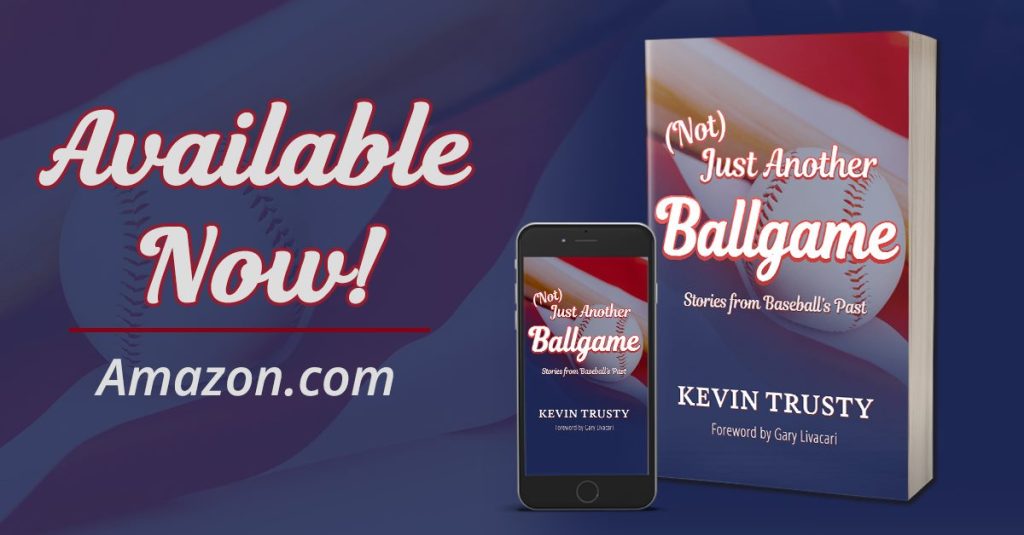
Such was the case first thing this morning when I received the email notification that (Not) Just Another Ballgame is now available! (The Kindle version is coming soon as well.)
Special thanks to fellow SABR member and baseball historian Gary Livacari for the wonderful Foreword. Also big thanks to Molly Errek, Denise Baran-Unland and Rebekah Baran and Todd Calcaterra for helping cover all things from design to editing to production and some crucial creative assistance.
Click the image below to visit Amazon and order your copy!
And of course, thanks to YOU, the baseball fan who may get a kick out of this project.
The manuscript for (Not) Just Another Ballgame is in the can, and the final editing process is underway.
We’re shooting for an early spring release, which is obviously just around the corner!
Designer Molly Errek once again delivers stunning cover art, which can be seen right here:
(Not) Just Another Ballgame, edited by Denise Baran-Unland and featuring a foreword by longtime SABR member, baseball historian and author Gary Livacari, is a collection of essays that highlight just a tiny few of baseball’s compelling moments from days long gone – with a couple more recent tales inside as well.
Here is the full chapter list:
A Lucky Bounce or Three: Washington’s Wild World Series Win in 1924
The AAGBBL Turns on the Lights at Wrigley Field
The Greatest Game Babe Ruth Ever Pitched?
The Brakeman Completes Another One
A Perfect Game, Perfected
The Clowning of Germany Schaefer
The Mays Malaise
Silence of the Bats: The 1917 White Sox Go Hitless Two Days In a Row
The Great Zim, Cocky Collins, and one Daring Dash for the Dish
Ruth’s Mysterious Gambit: The Final Out of the 1926 World Series
Johnson vs. Williams: The Forgotten Duel of 1918
The 1919 World Series: Did the White Sox Lose, or Did the Reds Win?
Mathewson’s Monumental Marvel of 1905
A Great Game Seven Finally Ends the Greatest Drought
Field of Dreams: Is the Beloved Classic Really a Baseball Movie?
Nevertheless, happy and excited to announce that the manuscript for (Not) Just Another Ballgame is complete. I submitted it to my editor yesterday, so the editing/revision process is officially underway.
The cover art for the book was completed yesterday as well, so stay tuned for that reveal.
Still hoping for an early spring release. More updates coming soon!
Excited to announce the initial details of my forthcoming collection of baseball essays, slated for a Spring release!
This collection focuses mostly on the Deadball Era of America’s pastime, but will include some more modern tales sprinkled in for fun. Many of the chapters in the book are built from earlier, condensed versions that appeared on this blog over the years. They have been expanded and enhanced for inclusion. As you stroll down hardball memory lane in this book, you’ll discover some fun bits of info such as:
Who played the actual first night game at Wrigley Field?
What happened with the mysterious final out of the 1926 World Series?
Has there ever been such a thing as a perfect perfect game?
Did the Chicago White Sox lose the 1919 World Series? Or did the Cincinnati Reds actually beat them?
What was the best game Babe Ruth ever pitched?
Is Field of Dreams really a baseball movie?
…and much more.
(Not) Just Another Ballgame will feature cover art by Molly Errek and a foreword by SABR member and baseball historian, Gary L. Livacari.
Final revisions are tentatively scheduled for early March, leading to a spring release.
More details coming soon!
Completely unofficial and far from final cover art
Hello all! Hope everyone had/is having a good holiday season!
As has been the case for the past year, I’ve been a bit bogged down with other projects which has kept me from posting as much here. I’ve recently considered writing about the current state of the Cubs, but that’s a sad road I’d rather not travel at this moment in time.
Rather, I’ll just announce a new project that is underway.
I’m compiling some of the greatest hits of this here site, and adding a few new tidbits for inclusion in a little book. I’m hoping to have this ragtag collection of baseball essays out sometime this coming spring, 2021.
Title, release info, and chapter teasers forthcoming.