An interview with baseball historian and author, Gary Livacari

Today we’re honored to spend a few moments with baseball historian, author, editor of the greatest page in the history of facebook, and lifelong Chicago native Gary Livacari! In addition to contributing content to SABR‘s great BioProject and several books, Gary has just published the fantastic Memorable World Series Moments, a collection of great stories from various fall classics of yesteryear, going all the way back to 1909. In this book, Gary compiles all the interesting, humorous and strange tales from some of the greatest World Series’ and their heroes of past eras with a reverence and boyish fascination that we, as baseball junkies, can all relate to.
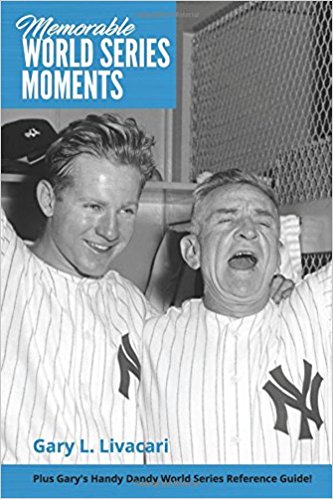
GaryBook

Gary, thanks for joining us today!

My pleasure!

So tell us, how did the idea of writing this new book come about?

I’ve always enjoyed writing, especially about baseball history, which is a subject I love and one that I happen to know a little bit about. I’ve been a SABR member for many years and have done numerous biographies for the SABR BioProject. For the longest time, I had been saying to myself it would be nice if I could combine my love of writing with my love of baseball history. I would often say to myself that “I have a book inside me somewhere, but I just don’t know what it is yet.”

That was the situation about four years ago when Ron Bolton asked me to join him as an editor of the Old-Time Baseball Photos facebook page. I started writing two or three short essays per week on different topics related to baseball history. It proved to be a great outlet for me, writing about subjects I enjoy. One of the continuing topics I wrote about over the years was “Famous World Series Incidents.” As time went on, I realized that I had written over 25 essays on different World Series’. Then the light bulb  went off: Why not compile all these essays into a book? There was my book, sitting right in front of my nose the whole time! So that became the genesis of the book, Memorable World Series Moments. 

Did you self-publish, or go through a publishing company?

I self-published. Amazon makes self-publishing, both e-book and paperback, very easy if you’re somewhat computer and tech-savvy. I had the entire project up and running and finished within six weeks, and it cost me very little. There’s a very limited audience for a niche subject matter like mine, so finding a conventional publisher for my idea would’ve been out of the question. So six weeks after coming up with the idea, I became a published author!

Why did you choose that particular publishing route so quickly?

One of my friends gave me the book Publish and Profit by Mike Koenigs. The theme of the book is how easy it is to self-publish, and how becoming a published author adds immensely to your credibility. It establishes you as an “expert” while opening up numerous doors (speaking engagements, etc.) Plus, it’s enormously self-gratifying. I suddenly had people asking me for my autograph which I humorously refer to as my “15 minutes of fame.”

What were the main differences in writing content for the book compared to your website, Baseball History Comes Alive! and the facebook page, Old-Time Baseball Photos?

Very little difference because my book is a compilation of short essays I had written and posted on my site and facebook page. I just did some editing prior to publishing the book. Plus I added to the book something I call Gary’s Handy-Dandy World Series Reference Guide. This is a compilation of World Series records and other bits of baseball trivia related to the World Series I had been collecting over the years. I thought this would be a good place to publish it.

Do you have a favorite chapter or story you wrote, and why?

My favorite chapters are the ones about famous World Series “goats” like Fred Snodgrass in 1912, Heine Zimmerman in 1917, Freddie Lindstrom in 1924, Ernie Lombardi in 1940, and Mickey Owen in 1941. For some reason, I had always been interested in these types of stories. Even as a little kid I had heard of these incidents, and always felt some sadness for these players who were blamed for losing the World Series. With just a little research, I found that almost invariably they were blamed unjustly. So I was glad to have the opportunity to write about them, hoping to do my little bit to set the historical record straight.

What was your biggest challenge and biggest reward from writing this book?

The biggest challenge was learning how to format the manuscript for publication completely by myself after I had finished the writing. I wanted to prove to myself that I was capable of solving all the technical issues that arose, so that it would be truly self-published. I found a couple e-books on the internet on self-publishing, and, to my amazement, I was able to complete the project without too many stumbling blocks. The biggest reward has been the positive feedback I’ve received. Most of the people who bought the book seem to genuinely like it!

What is it about baseball history in general that you find so appealing and interesting?

That’s an interesting question. I’ve been a Cubs fan since 1955 when I was 5 years old. I have fond memories of sitting on my Grandfather’s lap watching Cubs Sunday doubleheaders on our old black-and-white TV after Sunday dinner. I’ve been a baseball fan ever since. Those were wonderful old days, so there’s definitely an element of nostalgia for the past locked into my psyche. I’ve often said if you ask any baseball fan how he became a fan, you’ll almost always find a story similar to mine.

There’s just something about the “old days” of baseball that I’ve always found fascinating. I wish I could find the words to express this fascination. I think it’s basically an intangible, almost subconscious thing. I know it’s there, but I can’t really explain it. I’ve always been an avid student of American history (I’m somewhat of an authority on the Civil War), so perhaps that has something to do with it. In studying baseball’s past you can’t help but learn a lot about America’s past. Baseball is just intertwined into America’s history. But it’s deeper than that, part of one’s “makeup.”

Any plans for publishing more books in the future?

You bet! Now that I’ve got the first one successfully under my belt, I’m constantly tossing ideas around in my mind. And I wouldn’t mind doing something with Mr. Kevin Trusty!

Neither would I! I think we could come up with a fascinating project(s) and look forward to seeing what’s on the horizon there. Thanks for your time Gary, and congratulations on a great book! 

Thank you!


Buy Memorable World Series Moments here

Visit Baseball History Comes Alive!

Check out Old-Time Baseball Photos on Facebook!
The Greatest Game Ruth Ever Pitched

In the years before he became the near-mythical Yankees’ slugger he is known for, Babe Ruth was a terrific pitcher for the Boston Red Sox. In 1916, he was tops of the World Series champion’s staff, compiling a 23-12 record with an American League leading 1.75 ERA and 23 complete games in 323 innings pitched.

Arguably his pinnacle, if overlooked, performance was in Game Two of the 1916 World Series.

Image result for babe ruth 1916 world series

Playing at nearby Braves Field in Boston to accommodate a much larger crowd than could be squeezed into Fenway Park, the Red Sox entered Game Two with a 1-0 series lead over the Brooklyn Robins (later the Dodgers.) Ruth would take the bump against Brooklyn’s Sherry Smith, a solid hurler who went 14-10 with a 2.34 ERA on the season, in a battle of southpaws. What transpired was a tremendous 14-inning duel that left fans captivated as darkness descended on the then brand new Boston ballpark and certified Ruth as a true ace.

With two outs in the first frame, Brooklyn’s Hi Myers launched a ball off Ruth to right center that got past both Harry Hooper and Tilly Walker. With the two outfielders unable to corral the bounce off the wall, Myers chugged all the way around the bases for an inside the park home run. Neither team scored in the second, but the Red Sox were able to tie it up in the third when Ruth’s groundout scored Deacon Scott, who led off the inning with a triple.

For the next several innings both teams threatened, but gallant pitching by both Ruth and Smith and excellent defense held serve as neither team could flash a run across the dish. With the score still tied 1-1, the Red Sox’ Hal Janvrin led off the bottom of the ninth with a double. Pinch hitter Jimmy Walsh reached on an error, and Boston enjoyed runners at first and third with no outs. A fly ball from Dick Hoblitzell to center field promised to be the game-winning sacrifice fly, but Brooklyn’s Hi Myers, contributing from both sides of the plate, pegged Janvrin at home to preserve the tie. Larry Gardner would then foul out to end the inning and send Game Two to extras.

As was the case all day, both teams threatened in each of the extra innings but couldn’t capitalize. Daylight was fading now, and the game would’ve been ruled a tie if they couldn’t finish one way or another, soon. Brooklyn, trying to seize another opportunity, had their last best chance in the top of the 13th. With a runner on second and no outs, Sherry Smith, who was still on the mound, looped a liner to left field. Duffy Lewis, an outstanding defensive player in his own right, took a page from the Tris Speaker handbook when he tore in from deep left to make a sensational catch, saving a run and perhaps, the game.

Smith set Boston down in order in the 13th, and Ruth followed suit to Brooklyn in the 14th. It was now time for some classic deadball-era smallball by the Sox.

Hoblitzell led off with a walk and Lewis sacrificed him to second. Sox skipper Bill Carrigan inserted Mike McNally to run for Hoblitzell, and Del Gainer to pinch hit for the struggling Larry Gardner. The gamble worked, as Gainer roped a single to left field and McNally beat a strong throw by Zack Wheat to the plate, giving Boston the 2-1 victory and a two games to none lead in the series. They would go on to win in five games for their second World Championship in a row.

Not lost on the thrilling finale to this game was the incredible pitching by both Sherry Smith and the victorious Babe Ruth, both going the distance. Smith’s final line tallied 13.1 innings, scattering seven hits and two earned runs while walking six and striking out two. Ruth was even better, going the full 14 innings, allowing only six hits and one run, with four strikeouts and three free passes. The win not only put the Red Sox in the drivers seat to clinch the series, but it cemented Ruth as a big-game pitcher who really put an exclamation point on his stellar regular season. Two years later, Ruth would twirl another gem in the World Series, shutting out the Cubs 1-0 in Game One. As sterling as that was, his Game Two sensation against Brooklyn may have been better.

Ruth would enjoy a couple more strong seasons on the mound for the Red Sox, but by 1918 his bat really began to emerge, and 1919 saw him achieve true slugger status. Prior to the 1920 season he was sold to the New York Yankees, helping them create a dynasty and launching Ruth into his legendary status thereafter.

Yet long before having his likeness carved into the Mount Rushmore of baseball legends, the stocky kid from Baltimore was quite the sensational southpaw on the hill.

Sources: Braves Field: Memorable Moments at Boston’s Lost Diamond. Howlin & Brady, 2015.

https://www.baseball-reference.com/boxes/BOS/BOS191610090.shtml

https://www.baseball-reference.com/players/r/ruthba01.shtml

https://www.baseball-reference.com/teams/BOS/1916.shtml

Photo Credit: https://en.wikipedia.org/wiki/Curse_of_the_Bambino

Some History Is Hard to Repeat

If you ask Cubs fans to describe the 2017 season, many will say, “disappointing.” Perhaps that’s because of the way the season ended, in a completely flat offensive effort in the NLCS against the Los Angeles Dodgers. Maybe it’s also because something just looked off about this team all year, and they never fully clicked for whatever reason.

The tunnel vision vantage point may feel somewhat bleak, but stepping back, the panoramic view is pretty damn bright.

For if this season was “disappointing” and yet still yielded a 92-win Central Division title and a playoff run to the NLCS for the third straight year, that’s something to be pretty content with given Cubs history.

There’s that word again: History. As in, the past. As in, last year is over. As in, I think that’s where some of the fans’ disdain for how this season went down began. Here, then, is a good time to remember one of the chief lessons in baseball: No team, game, or season is ever the same.

The Plan worked. 2016 was magical. Not just because of the 108-year World Series drought ending, but in the way it happened. It was as close to an ideal season as any team could have. Literally a dream come true for long-suffering Cubs fans. In addition to having the deepest and most talented team in all of baseball, the Cubs enjoyed a red hot start that carried throughout the whole season save for a rough stretch just before the All-Star break. More importantly, this was a team with the rarity of near complete health all season save for Kyle Schwarber, who’s absence before coming back to be one of the World Series heroes was perfectly filled by the depth and flexibility of his teammates. Throw in the NL MVP, two Gold Glove winners in your starting nine, and two of the five starting pitchers in your rotation finishing second and third in Cy Young Award voting, and you have a recipe for a Championship season. And so it was done. (Not without three exciting series’ in the playoffs capped off by the greatest Game Seven of all time of course, but that’s another story altogether.)

2016 was as close to perfect as it gets. 2017 was not. And that’s ok.

For whatever reason, this year’s team stumbled early and often. The starting pitching wasn’t nearly as sharp, many bats slumped at once, there was a rash of injuries to several key players who missed significant time, the bullpen didn’t always hold serve and the platinum defense of 2016 regressed significantly. It took until after the All Star break for something to finally set right with this group, when they emerged from 5.5 games back on July 15 to win the division at the end of September. But still, something just didn’t look right.

There were notable offensive quirks by many players throughout the year. Kris Bryant hit .295 with 29 homers but only drove in 74 runs. Kyle Schwarber knocked out 30, but only hit .211 and that was due to a surge after coming back from the minors where he was sent after a couple months of living far below the Mendoza line. Addison Russell wasn’t the same, missed time with an injury and didn’t duplicate his production from the year before. Stalwart veteran Ben Zobrist had his struggles, and battled his health all season. Willson Contreras was having a monster year before being sidelined on the DL. Jason Heyward, under much scrutiny after a dreadful ’16, actually managed to hit 30 points higher and improved across the board in every offensive category, and yet still didn’t really pass the eye test and was benched for the second straight year in the playoffs for lack of production. Not that it was just him though, the entire team went flat against the Dodgers, losing four games to one and scoring only eight runs in the five games, all on home runs. The book was closed on 2017 with a major ebb, after not a lot of flow.

As I sit here writing this and listening to the excellent (and in context, very atmospheric) Pearl Jam – Let’s Play Two: Live At Wrigley Field record, I perhaps should be disappointed in the way this season ended, but I’m really not. In fact, I’m encouraged. For a team that battled through a lot of injuries, inconsistent play, individual struggles, and balls-to-the-wall competition in the division from the Milwaukee Brewers and St. Louis Cardinals (and earlier, the Pittsburgh Pirates), and still emerge with a third straight trip to the NLCS…well, its something I never thought I’d see in my lifetime. So really, 2017 wasn’t all that bad.

Granted, I’d be furious right now had 2016 not happened. In fact, I might start to believe that it never would happen.

In some ways, 2017 sort of felt like playing on house money. Sure I was hoping for a repeat, but baseball is the hardest sport to land a consecutive championship, so expecting one was a little unrealistic, even with the bulk of the 2016 team still here. The good thing however, was there was no pressure anymore. For all of the erroneous Curse believers, it was gone. Mission accomplished, and now we as fans could focus on the present and no longer the forlorn barrage of “what ifs” and “there’s always next year’s.” Cubs fans expect to win now, and make deep playoff runs, and for the third straight year, that’s what happened. Now this team can gear up for 2018 with a renewed focus, new faces on the roster and on the coaching staff (following the firing of pitching coach Chris Bosio yesterday), and perhaps a sense of unfinished business too.

Just remember, no team, game, or season is ever the same.

Four months until Spring Training…

Sources: https://www.baseball-reference.com/teams/CHC/2017.shtml

https://www.baseball-reference.com/teams/CHC/2016.shtml

The Curious Case of Gentleman George

George Sisler is a name seldom brought up when discussing the greatest ballplayers of all time. Given his career accolades and Hall of Fame status, that’s an injustice.

“Gentleman George”, also nicknamed “Gorgeous George”, was unquestionably the greatest player in St. Louis Browns history, and one of the games first truly elite first basemen. A quantifiable five-tool player, Sisler would play 12 of his 15 MLB seasons with the Browns, ending with a brief cup of coffee in Washington before finishing his career playing for three seasons with the Boston Braves. In that time, Sisler amassed a lifetime batting average of .340, good for 17th all time. Within that span, he would enjoy a mammoth 1920 campaign in which he hit .407 with 257 hits, a record that would last for 84 years.

As if that wasn’t enough, in 1922, Gentleman George would hit a whopping .420, while leading the league in hits, triples, stolen bases and runs scored. For his career, Sisler hit over .300 in 13 of his 15 seasons, over .350 five times, and over .400 twice. His offensive prowess, along with his base stealing ability and defensive wizardry that garnered him much comparison to the great Hal Chase, earned Sisler a rightful place on the stage at the inaugural induction ceremony in Cooperstown in 1939.

But like some other stars that rose through the deadball era, Gentleman George began his big league life as a pitcher. Albeit a short lived stint on the bump, Sisler did enjoy one or two grand accomplishments.

After graduating with a degree in mechanical engineering from the University of Michigan in 1915 (an extremely rare occurrence for ballplayers in that era), Sisler joined Branch Rickey’s Browns staff and posted a 4-4 mark with a 2.85 ERA in 15 games, a very strong body of work for a rookie on a second tier team. The highlight of those, and one that Sisler himself referred to as his greatest thrill in baseball (1), was a 2-1 complete game victory in which he out-dueled the great Walter Johnson. The game, in which George limited the Senators to six hits while striking out three, effectively was saved in the eighth inning by perfect execution of the infamous hidden ball trick. Ray Morgan opened the Senators’ eighth reaching on an error by shortstop Doc Lavin. Skipper Clark Griffith inserted Horace Milan as a pinch runner, who was then sacrificed over to second. On the bunt, Browns second baseman Del Pratt covered first, and after securing the putout, quickly tucked the ball under his right arm, unseen by everyone except Sisler. Moving about the hill in faux-preparedness to pitch to the next batter, Milan began his leadoff from second, when Pratt dove toward him with the ball. Umpire Billy Evans ruled the out and the Washington rally was stopped. Sisler would then finish them off in the ninth for the win.

Shortly thereafter, Sisler’s bat and glove were proving more valuable than his pitching arm, and so a few random appearances on the bump notwithstanding, he would be an every day position player instead, a path that would end in the Hall of Fame.

A year later however, in his second-to-last career start, Sisler would ironically again go up against Walter Johnson. On September 17, 1916, the two would square off at Sportsman’s Park in St. Louis, and again it would be Gentleman George with the upper hand, shutting out Johnson and the Senators 1-0. Sisler would go the distance, allowing six hits and striking out six for the final victory of his pitching career.

In 111 career innings, Sisler would run up a 5-6 total record, with an ERA of 2.35 and a 1.2 WHIP. While not staggering, and certainly nowhere near the echelons of his offensive numbers, this snapshot proves that he was more than capable of being an effective pitcher.

Due to often being on second division teams and having never played in a World Series, George Sisler is often overlooked and rarely discussed. While his Hall of Fame numbers as a first baseman are forever impressive, he did enjoy a few shining moments as a hurler as well.

Sources:  https://books.google.com/books?id=jlDWBgAAQBAJ&pg=PA70&lpg=PA70&dq=Browns+Senators+Hidden+Ball+Trick+1915&source=bl&ots=dGdDK-vRMi&sig=7uIqRXW5p59q65bUmxwNM5zdCRo&hl=en&sa=X&ved=0ahUKEwi1sYOTr6zWAhWL64MKHWQeAwIQ6AEIJjAA#v=onepage&q=Browns%20Senators%20Hidden%20Ball%20Trick%201915&f=false

https://www.baseball-reference.com/players/s/sislege01.shtml

https://www.baseball-reference.com/boxes/SLA/SLA191508290.shtml

http://baseballhall.org/hall-of-famers/past-inductions/1936-1939

http://baseballhall.org/hof/sisler-george

(1) https://sabr.org/bioproj/person/f67a9d5c

Rare Thievery For Shoeless Joe In Cleveland

Joseph Jefferson “Shoeless Joe” Jackson had many accolades in his 13-year MLB career.

His baseball life, although lengthy by deadball-era standards, was nonetheless sadly shortened for his role in throwing the World Series in 1919. Still, Jackson amassed a lofty .356 lifetime batting average, having never hit below .308 in any full-time season, a truly remarkable feat.

1912 was no different, really, in terms of being remarkable. Yet amid all the sensations Jackson would showcase before and after this season, one gem of a game is often overlooked.

Jackson had a fantastic .395/.458/.579 slash line for the 1912 season, to go along with 121 runs scored, nearly twice as much as the next highest player for the 5th place Cleveland Naps (Indians.) He would also swipe 35 bases that year to easily lead the team. On August 11th, in an 8-3 victory at League Park over the visiting New York Highlanders (Yankees), Jackson would take four bases and score twice in the game. That he totaled up those numbers is not surprising, but how he did it, is.

In the first inning, Jackson would keep his name in the discussion with the great Ty Cobb as being one of the few who could confidently steal home successfully. But Jackson wasn’t done yet. In the seventh, Shoeless Joe would achieve the rare stolen base cycle, swapping second, third and then home, in succession, in the same inning. At the time, Jackson was just the fifth player in MLB history to steal home twice in the same game, and even today he remains just one of eleven players ever to accomplish the sterling feat. That he did so while also stealing all three bases in the same inning makes this event stand out.

No player has stolen home twice in the same game since Vic Power pulled it off on August 14, 1958, ironically also while playing for the Indians, at home, and 46 years nearly to the day since Jackson’s marvel.

Image result for Shoeless Joe 1912

Ty Cobb, Shoeless Joe Jackson, Sam Crawford in 1912

While only eleven players have stolen home twice in the same game, swapping all three bases in the same inning is essentially equally as rare. To date, stealing all three bases in the same inning has happened just 50 times in baseball history. The most recent occurrence was by Dee Gordon on July 1, 2011 while playing for the Dodgers against the Angels in Anaheim. Pete Rose also did it in 1980, but before that nobody had done so since Harvey Kendrick in 1928. Some players just breathe rarefied air, even for one inning.

Nobody would ever consider stealing home twice in a game, or swapping all three bags in the same inning easy or commonplace, but don’t say that to Ty Cobb or Honus Wagner, as each man had a stolen base cycle in the same inning an astonishing four times in their careers. But for Jackson, stealing home twice and capturing all three bags in the same inning, both in the same game, was a phenomenal accomplishment.

Sources: http://www.baseball-almanac.com/feats/stealing_second_third_home.shtml

https://www.baseball-fever.com/forum/general-baseball/trivia/80231-i-stole-home-twice

https://www.baseball-reference.com/teams/CLE/1912.shtml

Photo Credit:

https://en.wikipedia.org/wiki/Shoeless_Joe_Jackson

The Brakeman

One of the overarching and never underestimated compliments of most early deadball-era pitchers (to me anyway), is that they were indestructible. That is, their arms were. A quick glance at the stats of late 19th/early 20th century legends like Cy Young, Pud Galvin, Old Hoss Radbourn and Cannonball Crane among others reveal some hysterical numbers in terms of innings pitched, games started, and complete games.

One of these dapper gents however, achieved a completely asinine feat that the rest did not: He threw 185 consecutive complete games.

Jack Taylor began his pro career in 1897 with the Milwaukee Brewers of the old Western League, a team managed by the great future Hall of Famer, Connie Mack. He broke into the bigs in 1898 after the Chicago Orphans (Cubs) purchased his contract later in the ’98 season where he remained until 1903. On June 20, 1901, Taylor took the loss in a complete-game performance against the Beaneaters (later the Braves) at the South End Grounds in Boston. This game would be the catalyst for nearly five years’ worth of completing every game he started.

Nicknamed “Brakeman Jack” for his occupation in the offseason, Taylor was a non-flashy, but tough-as-nails righty from Straitsville, Ohio.  His breakout season came in 1902 where he compiled a 23-11 mark with a sizzling 1.29 ERA, along with 34 complete games in 34 starts and was the league leader in ERA, WHIP (0.953) and shutouts (8.) After the regular season ended, the Cubs and crosstown rival White Sox engaged in an exhibition “City Series”, something that would become a Chicago tradition for many years. In this particular series, Taylor was accused of throwing a game to the Sox. Though nothing was ever proven, he was nonetheless traded during the winter of 1903 to the St. Louis Cardinals. The Brakeman was dealt along with Larry McLean for Jack O’Neill and a young, unproven and undervalued pitcher named Mordecai Brown. At the time, it seemed the Cardinals’ got the better half of the deal, but not long afterward that table turned as “Three Finger” Brown would go on to a Hall of Fame career with the Cubs and locked his own valued place in baseball lore.

Image result for Jack Taylor 1902

Meanwhile, Brakeman Jack’s complete game streak continued with the Cardinals, sealing up 39 of them to lead the league, along with 20 victories in 1904. Amid repeated accusations of throwing games, none of which were proven, Taylor became a fairly hot commodity. In 1906 he was traded back to the Cubs, and the timing couldn’t have been better, as there he joined an outstanding, now-famous pitching staff led by Brown, along with Orval Overall, Carl Lundgren, Jack Pfiester, and Ed Reulbach. The Brakeman added in his own 12-3 mark on the season, but ended his complete game streak at 185, after “only” completing 15 of 16 games that year. His ERA was a stellar 1.83 and a factor in the Cubs’ team ERA, which ended with an unheard of mark of 1.76 for the season. The Cubs would reach the World Series, but ironically fall to the crosstown White Sox, where the famed “Hitless Wonders” would do enough damage to the elite Cubs pitching staff to take the title. A year later, Taylor helped the northsiders back to the World Series, this time emerging as world champs after defeating the Detroit Tigers. 1907 would be Taylor’s final big league season, though he would bounce around in the minor leagues for several more years before finally hanging up his cleats in 1913. He returned to Ohio, worked as a miner, and died there in 1938.

For his career, Brakeman Jack Taylor would amass a 152-139 record, to go along with a career ERA of 2.65. Certainly nothing to scoff at there, but when you factor in his 2,626 innings and 20 shutouts, it’s hard not to consider Taylor among the elite, if certainly overlooked hurlers of the early deadball-era. The most impressive mark of course, being his MLB-record 185 consecutive complete games. That is absolutely crazy to conceive, in any era of baseball.

They sure don’t make ’em like that anymore, folks.


Sources: http://www.baseball-reference.com/players/t/tayloja02.shtml

http://www.baseball-reference.com/bullpen/Jack_Taylor_(tayloja02)

https://en.wikipedia.org/wiki/Jack_Taylor_(1900s_pitcher)

http://charlesapril.com/2009/08/closer-look-jack-taylors-complete-game.html


Photo Credits: http://www.baseball-reference.com/players/t/tayloja02.shtml

https://en.wikipedia.org/wiki/Jack_Taylor_(1900s_pitcher)

The Greatest College Baseball Game Ever Played

Game seven of the 2016 World Series between the Chicago Cubs and Cleveland Indians may go down as the greatest major league baseball game, or at least greatest game seven, of all time. The two thousand-plus inning exhibition game between the Cubs and all-stars from the Iowa Baseball Confederacy in 1908 in W.P. Kinsella’s The Iowa Baseball Confederacy is doubtless the greatest fictional baseball game of all time.

So what about the best game ever in college ball? Well, there certainly is one.

New Haven, Connecticut. Yale Field. May 21, 1981. NCAA Northeast Regional, first round.

Future MLB star hurlers Ron Darling of Yale, and St. John’s’ Frank Viola would square off in a pitchers duel reminiscent of  many deadball-era gems of several decades prior. Many of the game’s 2,000 spectators hung around the ballpark for the second game of the NCAA Regional doubleheader, hoping for a better contest than the earlier 10-2 drubbing of Central Michigan at the hands of Maine. They had no idea what they were in for.

Darling and Viola were deadlocked in a scoreless game in the ninth inning. Moreover, Darling had yet to give up a hit and no runner had reached third base. As the game entered extra innings, both pitchers’ pitch counts were skryocketing into the 170’s, but it had no effect on either arm. St. John’s catcher Don Giordano marveled at the movement that Darling had on his pitches all game long. “An unbelievable slider that broke like nothing any of us were accustomed to seeing,” Giordano said.

Yale managed to scatter several runners throughout the game, but Viola, dominant in his own right for the Redmen, held them scoreless. Darling was just a tick better however, taking his no-hit sensation into the 12th inning.

Stephen Scafa led off the top of the 12th for St. John’s and managed to muscle a soft liner off his hands into left field, ending the no-hitter by Darling. Everyone at the ballpark, including, in a great show of sportsmanship, the entire St. John’s team, gave Darling a standing ovation. “I’ll never forget this as long as I live: The St. John’s team came up to the top step of the dugout and gave me a standing ovation,” Darling said during a 30th-anniversary of the game in 2011. Even in the midst of a great battle, monumental moments are respected by those who respect the game.

The speedy Scafa, always a base-stealing threat, immediately swiped second.

Giordana then reached on an error by Yale shortstop Bob Brooke to put runners at the corners. Thomas Covino came in to pinch-run, and the Redmen called a double-steal on the very next pitch. Darling stumbled coming off the mound and thus could not cut off the throw, which went to second. Scafa froze at third while Covina got caught in a rundown. At the moment the ball was thrown to first, Scafa broke for home, sliding in safely to give St. John’s a 1-0 lead they would not relinquish.

Yale was unable to score in the bottom of the 12th against St. John’s closer Eric Stamphl and the game ended.

In a performance that would make Walter Johnson proud, Darling went the distance in the 1-0 loss, allowing just one hit and striking out 16. Viola twirled a gem of his own, scattering seven hits over 11 scoreless innings. The fans at Yale Field that day saw the greatest college baseball game ever played. A timeless pitchers duel that lasted three extra frames and was decided on a gutsy (and brilliant), display of smallball at the most opportune time.

It was the greatest spectacle of sport and strategy at the NCAA level, and 36 years later has yet to be outdone. It may never be.

‘Tis a strange and wonderful game, that baseball…

Sources: http://www.nationalpastime.com

Phantom First Basemen: Elite Company

Baseball, as we all know, is a game full of bizarre and bewildering situations. Many are often forgotten, or only briefly remarked upon by way of a footnote in a long-overlooked box score, or a mention from a researcher on one of those “On this day…” articles. Such was the case today, when glossing over http://www.nationalpastime.com I noticed a remarkable stat that occurred on this date 87 years ago. Looking a bit further into it, I was reminded of a very small handful of times where a team could have actually won a game without their first baseman.

On April 27, 1930, the Chicago White Sox defeated the St. Louis Browns 2-1 at Sportsman’s Park in St. Louis. The lone oddity of this game, was that White Sox first baseman Bud Clancy played all nine innings without recording a single putout, becoming the first player in modern baseball history to do so. (A.B. McCauley first accomplished the feat in 1891 while playing for the Washington Statesmen of the old American Association.) The Odell, Illinois native would have a largely vanilla nine-year major league career, mostly as a backup. Though he would end up with a solid .281 career batting average, he is most remembered for this strange day early in the ’30 season.

Wait. Is it considered a feat if a player technically does nothing?

What if he does it, er, nothing, twice?

Such was the case several years later for James Anthony “Ripper” Collins. A very good player by all accounts, Collins was late to the game, toiling in the minors for several years in the 1920’s and breaking into the majors in 1931 with the St. Louis Cardinals. He would have a breakout year in 1934, tying the great Mel Ott for the league lead in home runs with 35, and helping the famed Gashouse Gang of St. Louis to win the World Series. A year later on August 21, 1935, Collins would join Clancy when he would play all nine innings in a 13-3 win against the Braves in Boston, recording zero putouts. Two years later after having been traded to the Cubs, Collins would do it again. On June 29, 1937 in a game, ironically against the Cardinals at Sportsman’s Park, Collins and the Cubs would enjoy an 11-9 victory including zero putouts from the first baseman.

The strange occurrence would happen again nearly 40 years later, as Oakland’s Gene Tenace would join the Clancy/Collins ranks. On September 1, 1974 while playing with the World Series champion Oakland Athletics, Tenace would “help” his team earn a 5-3 win over Detroit at Tiger Stadium with no participation defensively from himself.

Fast forward another 41 years to July 5, 2015, and Red Sox slugger David Ortiz joined the list. In his first start at first base at Fenway Park in over nine years, Ortiz does not record a putout, though he did get an assist in the Sox’ 5-4 win over Houston.

Just four first basemen in the modern history of the game to essentially do nothing defensively to help his team win. Rare and odd, but evidently not impossible. It’s a strange game after all…

Sources: http://nationalpastime.com/

https://sabr.org/bioproj/person/95982dfa

http://www.southsidesox.com/2015/12/29/10680878/white-sox-feats-of-strength-bud-clancys-zero-chance-game

https://sports.yahoo.com/blogs/mlb-big-league-stew/david-ortiz-did-something-no-red-sox-first-baseman-has-ever-done-004547771.html

http://www.baseball-reference.com/players/c/colliri02.shtml

http://www.baseball-reference.com/players/c/clancbu01.shtml

http://www.baseball-reference.com/teams/WAS/1891.shtml

http://www.baseball-reference.com/teams/STL/1935-schedule-scores.shtml

http://www.baseball-reference.com/teams/CHC/1937-schedule-scores.shtml

http://www.baseball-reference.com/teams/OAK/1974-schedule-scores.shtml

http://www.baseball-reference.com/boxes/BOS/BOS201507050.shtml

2017 MLB Predictions

Image result for major league baseball

Well folks, here we are! The 2017 season has arrived (today is Opening Day in fact, so I realize I’m a bit late on this.) I debated all offseason on whether to do a predictions post, but in the end, and by the end I mean about 4 minutes ago, I decided why not? So, here goes it, my prognostications for this year:

AL EAST

  1. Boston Red Sox – They’re loaded. Having David Price banged up to start the year won’t help, but picking up Chris Sale will, as he historically has dominated the division.
  2. Toronto Blue Jays – Balanced and potent. They should be in the picture.
  3. Baltimore Orioles – Talented and consistent, and Buck Showalter will keep them relevant.
  4. New York Yankees – Could easily finish higher. 2-5 in this division could end up anywhere.
  5. Tampa Bay Rays – Should be competitive, but an overall lack of offense will likely keep them at a distance by September.

AL CENTRAL

  1. Cleveland Indians – Like Boston, they’re loaded and hungry. Will the 69-year World Series drought come to an end?
  2. Kansas City Royals – Injuries decimated them last year. If healthy, they should contend.
  3. Detroit Tigers – Getting older, but don’t count them out just yet.
  4. Minnesota Twins – Imploded last year but they have lots of youth and talent. If they can gel, they can finish higher.
  5. Chicago White Sox – Finally in a needed rebuilding mode and seem to be doing it right. Some feel there’s still enough there to be competitive all season, but it could be a rough year on the south side, especially if the long-rumored trade of Jose Quintana actually happens.

AL WEST

  1. Houston Astros – Good talent mix up and down and they’re ready to win. Dallas Keuchel is the key cog in their rotation. If he bounces back, it’ll be a huge plus for them.
  2. Texas Rangers – Solid, though may need to find an arm or two. Should be in the race all season.
  3. Seattle Mariners – Could be a sleeper team. Balanced lineup, little gray area on their pitching staff, but they feel ready to win this year.
  4. Los Angeles Angels – Should be better if they stay healthy but not quite ready to challenge the division.
  5. Oakland Athletics – The rebuild continues.

NL EAST

  1. Washington Nationals – Will we see the Baker Effect part II? Lots of pressure for this team to advance in the playoffs. They have the roster to do so.
  2. New York Mets – The most formidable starting rotation in the bigs, but they must stay healthy. If they do, this team could be extremely dangerous.
  3. Miami Marlins – Talent to be competitive, but depth and potential emotional hangover from the tragic death of Jose Fernandez will be factors.
  4. Philadelphia Phillies – Continuing rebuild, but trending up. Could grab a few more wins than people expect.
  5. Atlanta Braves – Lots of people seem high on this team to finish middle or upper in the division. They still are likely a year away, but like the AL East, positions 2-5 could be in any order.

NL CENTRAL

  1. Chicago Cubs – The defending World Champs are the best team in baseball, unequivocally. Sustaining that success now becomes the challenge, but this team has the depth, youth, flexibility and brains to do so.
  2. St. Louis Cardinals – Instantly better with the signing of Dexter Fowler, but losing Alex Reyes for the season was an unexpected blow. Still, there’s enough here to remain in the playoff picture.
  3. Pittsburgh Pirates – Arguably the best outfield in baseball and plenty of promise in the infield too. Will it be enough to climb back into the race?
  4. Milwaukee Brewers – Need pitching. Likely a mid-lower division finish looms.
  5. Cincinnati Reds – The full rebuild continues.

NL WEST

  1. Los Angeles Dodgers – Strong overall team and Dave Roberts proved in his first year as skipper he’s a trusted leader. If Rich Hill steps up to solidify their rotation, another division title awaits for these guys.
  2. San Francisco Giants – Picking up Mark Melancon was huge for them to bolster their bullpen, but a lack of big bats in their lineup could be a detriment. Still, a team of very good, dependable players will keep them on pace with the Dodgers all year.
  3. Colorado Rockies – Another potential sleeper team who could surprise. Pitching is always a question mark here, but there is a very potent lineup and solid defense that could enable this team to win.
  4. Arizona Diamondbacks – New managers always bring some new questions, but overall a lack of depth will be a major hurdle come the dog days of summer.
  5. San Diego – In rebuild mode.

There you go, folks. We’ll see how it shakes out as the season progresses and check in at the All-Star break to see how my semi-educated guesses are playing out. Enjoy the season!


Photo Credit: http://bsndenver.com/it-is-time-for-major-league-baseball-to/

A Draft Day Adventure

Lost in a world of fantasy, look what you’ve done to me.”

Yeah, that was a nod to a sizable hit song from 1982, remember? No? What about the Canadian rock band Triumph, who wrote it? Geez, what about the mega hit “Fantasy” by Aldo Nova? How about…crap, never mind. You may have known somewhere in the far recesses of your subconscious mind that these songs existed, but their details were very sketchy, at best. Basically, you don’t remember these songs any more than I remembered just how to play fantasy baseball.

You can imagine then, that I was a little concerned heading into last weekend’s draft, feeling like a mechanic from the 1970’s who started working on cars again in 2017 after a long time away. Sure, cars still have four wheels and an engine, but what makes them actually go is radically different from what he remembers.

This 2017 season is not my first foray into the world of fantasy baseball per se, but it is my first jaunt into this modern age of the game. You see, the last time I delved into this universe, the internet didn’t quite exist and you had to mail in your draft picks and lineups. Yes, that mail. So, here we are today and after some weeks of not-too-strenuous convincing and courting by a group of friends whom I share a mutual passion not only for baseball but specifically the Cubs with, I joined their league. Mind you, this is a league that is some 16 years old, give or take a foggy year or two at it’s inception during those joyous college years. Yep, this is me: Don’t try and join a startup league with fellow noob’s (as legions of basement-dwelling World of Warcrafters might call me), or a basic online league like I participated in, sort of, once before. Nope, just join a full 12-team keeper league full of veteran, extremely smart, analytical players. It’s going to be fun they said.

I started my prep with no singular direction, and outlined a list of players at each position without too much intricate research. I honestly had neither the time, nor the die-hard inclination. As a league rookie, I first got to participate in a mini-expansion draft with a fellow new team to the league and, actually, I think I did OK here. Selecting from a short list of available players who weren’t kept from last season, I managed to snag Johnathan Lucroy, Adrian Beltre, Brandon Crawford and Javier Baez. Not a bad start.

Draft day arrived and I was filled with excitement and anticipation, but also a modicum of fear as I didn’t want to completely Lewis Skolnick myself in front of a room full of long-time players. The auction rounds came and went, and my initial goal was to try and spread the wealth a bit to get a decent number of good players. Five buys later, mission accomplished. It was then that things began to trend in a direction that was less than upward, but not entirely to the trajectory of the Titanic‘s ultimate buoyancy in the North Atlantic, either. When it was all said and done, I took a look at my roster, feeling pretty OK about my performance. While I didn’t get remotely close to every player I had targeted (who does?), I still felt I had a roster of players who could deliver consistency in multiple categories. On second look however, I noticed two overarching themes:

Youth.

Health.

I don’t have a lot of either on my roster.

I do seem to have a good amount of power with guys like Lucroy, Beltre, Mark Trumbo, Giancarlo Stanton, Wil Myers, and Mr. Do-It-All Charlie Blackmon (easily my best pick of the draft.) Then comes a bench with what ended up being multiple catchers, but whom can also DH, a semi-surprising 22nd-round pickup with Josh Bell, and Kansas City utility man Whit Merrifield, who sounds like an Alpha Beta pledge at Adams College if ever there was one.

While the position players may be adequate, the pitching staff is cause for concern. Anchored by three injury/loss-of-stuff risks with Chris Archer, Jake Odorizzi and Zack Greinke. A couple mid-level starters with James Paxton and Gio Gonzales round things out with Sam Dyson and Kyle Barraclough (whom I admittedly drafted about 12% due to his name), in the mix as well. Draft snafu #2 happened nearly too late of course, when I realized somewhere around the 19th round that I had no true closer, and all the big guns were long off my board. I had to settle, for now, on Huston Street, who promptly began suffering from some sort of ailment (again.) Not a great sign. But sort of fitting, in a way. I’m the dumbass who overlooked that spot on my roster.

What’s the point of all of this you ask?

None, really. I just wanted to write something, I haven’t written about fantasy baseball before, and figured I’d throw this yarn of shameless self-deprecation out in the universe and open the floor to mocking, laughter and sneers. Hopefully it works out and I can maintain something above the level of animal excrement for the season.

But I’ll keep an eye on that waiver wire too.