Booze, Lightning and Death. The ’19-’20 Indians Redefine ‘Taking One For the Team’

Simply put, the Cleveland Indians of 1919-1920 had one of the most bizarre and both fortunate – and unfortunate – runs to a World Series championship in baseball history.

Led by the great player-manager Tris Speaker, the Indians benefited immediately from the Red Sox dismantling after the 1919 season, and later from the public unrest and inner turmoil from the 1919 World Series that plagued the White Sox down the stretch in the 1920 pennant race, before eight of their star players were suspended that September. After finishing a strong second in 1919, the Indians picked up in 1920 right where they left off. They captured the AL pennant, and then proceeded to beat the Brooklyn Robins (later Dodgers), to win their first World Series in franchise history.

Along the way, however, were two incredible incidents in August 1919 and August 1920 that were never seen before, or have been since. The first of which was where the Indians caught lightning, literally, with the signing of a pitcher.

In a late-season deal in 1919, the Indians acquired pitcher Ray “Slim” Caldwell from the Yankees. A solid pitcher, but unfortunately known more as an underachiever caused by his drinking, carousing and penchant for buggery than his accomplishments on the hill. Caldwell was always regarded as a player with extraordinary talent, but who loved the bottle more than the game. Speaker, though, felt he could get through to the 31-year old veteran and help the Indians win the pennant. To do so, Speaker had to put a special (and rather ridiculous), clause in Caldwell’s contract. It read:

“After each game he pitches, Ray Caldwell must get drunk. He is not to report to the clubhouse the next day. The second day he is to report to Manager Speaker and run around the ball park as many times as Manager Speaker stipulates. The third day he is to pitch batting practice, and the fourth day he is to pitch in a championship game.” (1).

After confirming that there were no errors in this absurd clause, Caldwell shrugged and signed. What happened next was both figuratively and literally a sign from above.

On August 24, Caldwell made his first start with the Indians, against the Philadelphia Athletics at League Park in Cleveland. Leading 2-1 with two outs in the top of the ninth, a thunderstorm suddenly rolled in, throwing bolts of lightning all around the ballpark. One such bolt struck Caldwell square in the head, knocking him to the ground, unconscious. One account has the bolt striking the metal button on the top of his cap, then exiting through the metal cleats in his shoes. After several minutes, Caldwell got back up and demanded he finish the game, which he did. Amazing. So amazing was it in fact, that years later he later appeared on the Ripley’s Believe It Or Not radio show (2).

Speaker’s odd plan worked, as Caldwell won five of his six starts with the Indians, with a cool 1.71 ERA in that span. He would continue his strong, and focused, performance in 1920, going 20-10 and helping the Indians get their rings. Speaker’s plan, and a little electricity through the brain, apparently knocked something right for Caldwell.

One year later, almost to the day from Caldwell’s bout with the bolt, tragedy struck.

On August 16, 1920 in a key game against the Yankees at the Polo Grounds in New York, Cleveland’s star shortstop Ray Chapman came to bat in the fifth inning. Submarine-style Yankee pitcher Carl Mays uncorked a fastball that hit Chapman in the left temple, knocking him flat to the ground. He died 12 hours later in a New York hospital, becoming the first and only player to have died from an injury sustained in an MLB game.

Despite the terrifying ordeal, Speaker was able to rally his team down the stretch and slip past the collapsing White Sox by two games to take the pennant, and then the World Series 5-2 over Brooklyn.

It’s a strange, eerie, and sad game. For the two seasons of 1919 and 1920, the Indians experienced as much, or more, of all of that than anyone in baseball. Credit must be given to the great Tris Speaker here too. Regardless of certain gambling accusations that would later tarnish his Hall of Fame career, Speaker did an incredible job not just playing (he only hit .388 in 1920), but managing his club in the wake of strangeness and tragedy, and utilizing a then-new platoon system for most of the season which was key in keeping his players fresh. ‘Ol Spoke and the boys got it done.

Sources:

(1) Tris Speaker: The Rough and Tumble Life of a Baseball Legend, Timothy M. Gay, The Lyons Press, 2007.

http://www.baseball-reference.com/teams/CLE/1920.shtml

(2) http://sabr.org/bioproj/person/8311d756

http://www.baseball-reference.com/players/c/caldwra02.shtml

A Perfect Game, Perfected?

To date, there have been just 23 perfect games thrown in over 210,000 Major League Baseball games played. The feat is equally as rare as it is incredible. But has there ever been such a thing as a perfect perfect game? Cleveland’s Addie Joss may have given us the answer 108 years ago.

Some historians consider the 1908 season one of, if not the greatest in the history of baseball for it’s two tightly contested, down-to-the-wire pennant races in both leagues, the famous Merkle Game becoming the most controversial in baseball history, and on a sad note, even a couple riots and deaths. Packed in the midst of all that stretch run craziness was a key October game between the Cleveland Naps (Indians) and the Chicago White Sox, who were both neck and neck with the Detroit Tigers for the American League pennant. It was a must-win contest for both teams and the fans at League Park in Cleveland expected to see a good game between Hall of Fame hurlers Addie Joss and Ed Walsh. What they got however, was maybe the greatest pitching duel of all time.

“So grandly contested were both pennant races, so great the excitement, so tense the interest, that in the last month of the season the entire nation became absorbed in the thrilling and nerve-racking struggle, and even the Presidential campaign was almost completely overshadowed”

Sporting Life, October 17, 1908.

“Big Ed” Walsh was on that day for the Sox. In fact he was utterly brilliant, going the distance and allowing just one unearned run on only four hits while striking out 15. And he lost.

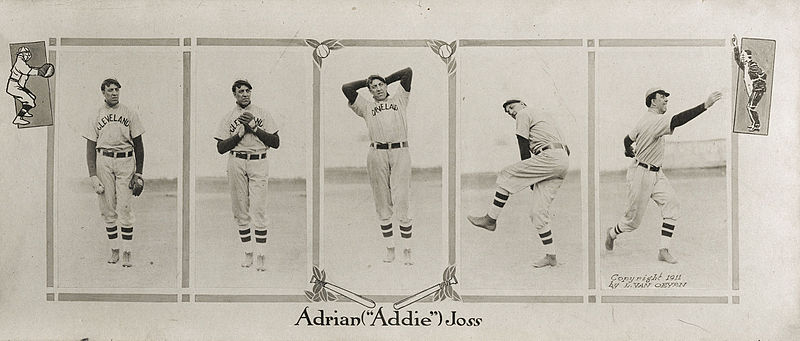
Addie Joss, an extremely likable fellow by all accounts was just a tick better than Walsh that day. His unique corkscrew-style windup and blazing fastball cut down the pale-hosed hitters, and it wasn’t until after the sixth inning that fans began to realize that no Sox player had reached base. Joss’ teammates on the Naps (as they were nicknamed then in honor of their star player-manager Napoleon Lajoie), began to avoid him in the dugout between innings, a tradition that carries on to this day during any no-hitter in progress. The throng at League Park followed suit, and the final innings were viewed in silence, a scene that must have been quite eerie to behold.

Image result for Addie Joss

Down 1-0 in the top of the ninth and desperate to score a run, the White Sox turned to their bench. The first two batters went down quickly. With two outs, veteran “Honest John” Anderson, a strong lifetime .290 hitter stepped to the plate and if League Park could have been quieter than silence at that moment, it was. “A mouse working his way along the grandstand floor would have sounded like a shovel scraping over concrete,” wrote one reporter. With the count 0-2, Anderson rapped a grounder to third, where Bill Bradley, almost too casually, tossed to George Stovall at first. Stovall dug the low throw from the dirt in a nice play, but the ball popped out of his mitt. Fortunately, he was able to grab the ball in time for the 27th and final out of the game. It was then that League Park, lips sealed in a reverent, church-like fashion for the past couple innings, finally erupted. On a huge day where a win kept the Naps in the pennant race and virtually eliminated the Sox, one of the best pitching contests of all time ensued. Joss rose to a new height that day, throwing the second perfect game in big league history and maybe the most perfect game of all time. Not only was the stage huge, but Joss’ efficiency has never been matched.

He only threw 74 pitches.

With the AL pennant in sight, the Naps would race the Tigers to the very end, with Detroit squeaking past by just a half game. The Tigers would face the mighty Cubs in the World Series, losing four games to one.

Joss would finish the 1908 season with a strong 24-11 mark and a blistering ERA of 1.16. He would win 14 more games the following season and only make a handful of starts in 1910 while battling injuries. One of those starts was another no-hitter against the White Sox, also by a score of 1-0. The following year, Joss fell ill during spring training. By the time he was diagnosed with tuberculosis, the disease had set on too rapidly and reached his brain. Joss died April 14, 1911 at the age of 31. For his all-too-short nine year career, young Addie racked up 160 wins, 234 complete games, 45 shutouts, two no-hitters including a perfect game, and a lifetime ERA of just 1.89 which is second only to, ironically, Ed Walsh. His career WHIP of 0.96 is the lowest in MLB history.

In a short, but stellar career, Addie Joss earned much respect from teammates, fans and competitors alike. On this one day in October 1908, he not only delivered at a time his team needed it most, but in doing so he turned in perhaps the most perfectly efficient perfect game that baseball will ever see.

Sources: “Crazy ’08: How a Cast of Cranks, Rogues, Boneheads, and Magnates Created the Greatest Year In Baseball History”, Cait Murphy, HarperCollins.

http://www.baseball-almanac.com/boxscore/10021908.shtml

http://www.baseball-reference.com/players/j/jossad01.shtml

http://www.baseball-reference.com/players/w/walshed01.shtml

http://www.baseball-reference.com/leaders/earned_run_avg_career.shtml

http://www.baseball-reference.com/leaders/whip_career.shtml

Photo Credits: https://upload.wikimedia.org/wikipedia/commons/thumb/1/13/Addie_Joss_five_frames,_1911.jpg/800px-Addie_Joss_five_frames,_1911.jpg

Mathewson’s Monumental Marvel

The New York Giants sure had a swell season in 1905.

Actually, it was tremendous. And the way it ended was ridiculous. Many modern glory stories are made of the Madison Bumgarners, Clayton Kershaws and Corey Klubers of the baseball world who throw key postseason innings on short rest. Rightfully so, of course. But what happened at the end of this particular season of a bygone era, if you frame it by today’s standards, is truly amazing.

The feisty John McGraw led his club to a staggering 105-48 mark on the ’05 season, including an all-too-brief but now-famous appearance in a June 29 game in Brooklyn by a young outfielder named Archibald “Moonlight” Graham. The Giants’ season ended, of course, by capturing the National League pennant and then drubbing Connie Mack’s powerful Philadelphia A’s four games to one in the second ever World Series. But what makes this series so interesting 111 years later is it featured the single most incredible performance by a starting pitcher we may ever see. His name was Christy Mathewson.

Image result for christy mathewson 1905
The great Christy Mathewson, 1905

Pitching was the name of the game in the deadball era, and 1905 saw a slew of it, especially on the Giants. This was a starting rotation so strong that the number five hurler, lefty Hooks Wiltse, compiled a 15-6 record with a 2.47 ERA in 197 innings, with 18 complete games and a WHIP of just over 1. Today, such numbers would put a pitcher squarely in the Cy Young Award conversation. Back then, it was considered no more than “pretty good.” Of course, Wiltse’s season numbers paled in comparison to Mathewson’s who went 31-9 with a 1.28 ERA, and tossed a mammoth 338 innings while completing 32 of 37 games started. And that’s not even the ridiculous part. That would come in the World Series.

“Mathewson pitched against Cincinnati yesterday. Another way of putting it is that Cincinnati lost a game of baseball. The first statement means the same as the second.”

– Writer Damon Runyan

Mathewson was completely untouchable in Games 1 and 3 of the Fall Classic, blanking the Athletics 3-0 and 9-0 with just three days separating the two shutouts, and he wasn’t done there. With the A’s on the verge of defeat, Mathewson took the bump again in Game 5 on two days’ rest and slung another shutout, goose-egging Mack’s men 2-0 at the Polo Grounds and sending New York into a championship frenzy.

For the series, Mathewson’s totals were astonishing: 27 innings, 0 runs, 13 hits, 1 walk and 18 strikeouts. He did all this in just five days.

In any era of baseball, there has never been anything like what Mathewson did in the 1905 World Series. It was a hell of an exclamation point on an already stellar season and it’s the type of feat, especially only taking a few days to accomplish, that we’ll never see again.


Photo Credit: https://radbournsrevenant.com/wp-content/uploads/2016/12/c65ea-spchristymathewsonportrait2.jpg

Sources: http://baseballhall.org/discover/inside-pitch/christy-mathewson-throws-third-shutout

http://www.baseball-reference.com/postseason/1905_WS.shtml

http://www.baseball-reference.com/players/g/grahamo01.shtml


The Great Zim, Cocky Collins, and One Mad Dash For the Dish

October 15, 1917, the Polo Grounds. World Series Game 6: Chicago White Sox @ New York Giants.

The Series’ clincher for the Sox was not without some controversy, and 99 years later certain elements of one particular, pivotal play, remain in question. The play, of course being the botched rundown of Eddie Collins in the top of the fourth inning, which ended up being the winning run, and cemented Giants third baseman Heinie Zimmerman as the goat. But was that an unfair label?

Image result for heinie zimmerman 1917
Heinie Zimmerman in 1917 at the Polo Grounds

Zimmerman, a stalwart, but maligned infielder in the back nine of his career in ’17, was no stranger to implication. Throughout his 13 years in the bigs, Zimmerman was often in questionable situations of all sorts, and he earned a reputation as a ballplayer who was never quite as good as he should have been (1). His subpar play in the 1917 Series only served to fuel such talk. In six games, he batted just .120 and committed three errors, the last of which was a costly throwing error that allowed Eddie Collins to reach first base in the crucial fourth inning of game six. Collins would subsequently score the winning run on the famous chase to the plate.

The Rundown

With Collins on first, Shoeless Joe Jackson lifted a flyball toward Giants right fielder Dave Robertson, who dropped the ball, advancing Collins to third and Jackson to second. Sox slugger Happy Felsch then rapped a grounder back to pitcher Rube Benton, who wheeled and threw to Zimmerman at third, having caught Collins breaking for home. The rundown started normally, until Collins slipped past catcher Bill Rariden who was caught too far up the line. Inexplicably, neither Benton or first baseman Walter Holke was covering the plate! Zimmerman was thus forced to chase Collins all the way home. Collins, the faster runner, beat Zimmerman to the dish, giving the Sox a lead they would keep. They would go on to win the game and the World Series.

Some sources have conflicting reports on what Rariden actually did. Most agree he took at least one throw from Zimmerman, threw it back, but by then he was too far up the line and Collins ran past him. Other reports make it seem that Rariden was hardly engaged in the rundown at all, having broke far up the line immediately, leaving Zimmerman nobody to throw to from the outset. With obviously no video of this play, these details may never be fully revealed.

The snafu’d rundown, along with his lackluster play in the first five games and the key throwing error on Collins’ grounder, made Zimmerman the fall guy in New York. He would long be mentioned in the same vein as other infamous Giant goats like Fred Merkle and Fred Snodgrass, having to vehemently deny accusations that he allowed Collins to score.

Where the hell was everybody?

In that rundown situation, with the catcher and and third baseman engaged with the runner, the question becomes why didn’t either Rube Benton or Walter Holke cover the plate? There should have been at least one, if not two backups for catcher Bill Rariden, regardless of how long he stayed in the rundown, yet there were none. Once Rariden was out of the play, Zimmerman had nobody to throw to. He famously asked after the game “Who the hell was I supposed to throw to, (umpire) Bill Klem?” And Zimmerman was right. Even skipper John McGraw placed the blame on Benton and Holke for not covering the plate, but the fans and media alike would continue to assault Zimmerman for the broken play, no doubt aided by his poor series, crucial error early in the inning, and a string of insinuation and questionable actions throughout his career.

The eyebrow-raising  would continue for Zimmerman the next two years, especially after first baseman and master game-fixer Hal Chase, formerly of the Cincinnati Reds, would join the Giants in 1919. McGraw, taking a gamble (no pun intended), on signing Chase in an effort to straighten him out would see the plan backfire as Chase and Zimmerman would form a potent betting duo. A grand jury was convened to investigate gambling in baseball in 1920, and McGraw and other Giants players would testify to Zimmerman and Chase’s agendas for fixing games in 1919. In the wake of the famous Black Sox scandal that season, Judge Kenesaw Mountain Landis would ban both Zimmerman and Chase from the game (2).

The sad tale of Heinie Zimmerman remains an interesting piece of baseball history. For although his reputation of never fulfilling his great potential drew the ire of fans and reporters, and his sidekicking with Hal Chase surely sealed his fate, he should not be to blame for the ’17 Series. He made the only play he could’ve made. The extenuating circumstances surrounding him and that series unfortunately made him the goat.

Unfairly.


Photo Credit: https://upload.wikimedia.org/wikipedia/commons/thumb/b/bf/Heinie_Zimmerman.jpg/220px-Heinie_Zimmerman.jpg

Sources:

http://www.thisgreatgame.com/1917-baseball-history.html

http://www.baseballhistorycomesalive.com/heinie-zimmerman-chases-eddie-collins-across-the-plate-in-the-1917-world-series/

(2) http://z.lee28.tripod.com/therest/heiniezimmerman.html

http://www.baseball-reference.com/boxes/NY1/NY1191710150.shtml

(1) http://sabr.org/bioproj/person/e73e465a

Walk(er)ing In a Wiffleball Wonderland

Baseball, as we know, can be played in many variations. Arguably the most popular of those, is Wiffleball. Through the decades, countless backyard get-togethers, sandlot pickup games, or even entire, official leagues have been created to enjoy this simplistic, joyous take on America’s pastime. One such legendary league, was the Walker Wiffleball League (1986-1994.)

While not as grandiose as Major League Baseball, nor as obscure as the Iowa Baseball Confederacy, the WWL more than held it’s own for many years on the dusty outskirts of Joliet, IL. Today we’re thrilled to have a visit with fellow baseball junkie and the founder, commissioner, and namesake of the WWL, Chris Walker. Join us on a hilarious and fascinating little journey back to the days of the WWL, and the grassy thrill of Hank Gathers Memorial Stadium.

Image result for Wiffle Ball

Q: Chris, thanks for joining us today!

A: My pleasure.

Q: Let’s jump right in: When and how did the WWL begin and end? What made you decide to start an official league?

A : It began in 1986 and ended in the fall of 1994. In the beginning we were always outside playing baseball, but sometimes we just didn’t have enough people to play so I wanted to create a way to play some form of baseball even if we only had a few kids. It was trial and error for the first two years and in 1988 we established rules and kept stats, but we still were ironing out kinks, trying to figure things out, etc. I think the final product ended up being rather impressive.

Q: You wrote a very thorough rule book, kept stats for each game and player, and compiled them into season and career-long variations. What effect did that level of depth have on the league?

A: I think it’s something that was truly original, especially when you add in that we even videotaped some games with the old huge VHS recorders and a couple times we broadcast game via CB even though we really had no one listening except someone else who was out there sitting in his car in the cul-de-sac. I can’t even imagine what the league would be like if I was a kid today with advanced technology, social media, youtube, and shit like that. I can’t imagine if I was born in 2002 rather than 1972 and was just getting started in doing such a thing. As amazing as I think my product was, and it truly was a product, we would’ve done some ridiculous things.

Q: Were the seasons made up of just one-off games or did you orchestrate a playoff structure of any kind?

A: It was pretty much guys showing up, picking teams and playing a bunch of games. We did schedule some tournaments where people picked their own teams, which was also a lot of fun. Some nights we’d have good matchups and play a best-of-3 series, which also was pretty cool to do.

Q: Did the WWL ever host any special events? All-Star games? Tournaments? Etc.

A: We’d have home run derbies, tournaments and some special events. We had Kautz Fest (after player Dan Kautz who was leaving to go into the military) where we decorated the park and it looked more like a used car dealership for a few days. I think one of the cooler things we did was play music during night games, and in the early 90s there were some great releases. I’m pretty sure that some people first heard of Alice in Chains, Nirvana, Pearl Jam and Soundgarden while playing wiffleball with their buddies. You’re welcome.

Q: This was all long before the days of the internet and social media so where did the players come from? Was it just among local family and friends or did any players travel from further away?

A: It was primarily word of mouth. Obviously I had my friends in high school from ‘88-90 and then I went to Joliet Junior College so I met some guys there in ‘90-92 who got involved before I went away to Southern Illinois at Carbondale. I was also umpiring a lot of youth baseball so some fellow umpires also got into the action and I was playing rec softball a few nights a week so there were guys I met there as well.

Q: You built a custom field, complete with lights for night games. Tell us about the layout, dimensions, special features, and how the building process came about.

A: Our yard had a weird shape to it and the majority of the backyard was fenced in, but outside of it, we also had property, plus there was an open lot adjacent to it. Technically, part of the field, the home plate area, wasn’t even on our land. Dimensions were 110 down the lines and 100 to center, which is opposite of a traditional baseball field, but played into the game we created. With a pitcher and two fielders, a hitter might be inclined to try to hit it to center with the short fence, but you also had two fielders converging to deal with, as well as the pitcher. The first two years were a bit different, but we worked on adjusting the field to have it set up this way with the same distances, etc.., and then we did the wall like a MLB park and installed permanent lights, a backstop, wooden benches. Part of the fence is hanging in my garage now.

Q: How much, if any, documentation still exists from the WWL days? (video, statistics, photos, articles, etc.)

A: It’s a mix. Sadly, no one really ever took photos. I fortunately have a dozen or so photos that I took of the field itself, mostly toward the end in 1994. If we played today, can you imagine the number of photos we’d have with cell phones? It also would’ve made it easier to set up games. I’m guessing there are about 25-30 games that I have on video as that was sporadic, but it’s better to have some rather than none. I still need to take the time and total up career stats, which is something if I ever get some free time, I’d love to do. I wouldn’t mind putting up a website documenting the league and its history. Of course, there’s no better way to relive the history than the Game Summaries. I kept one for every game played from 1988 through 1994. I have several enormous binders from every season with the box scores and details of what happened that night. It’s diary-like. Luckily, I like to write and Jason Switzer, who was heavily involved in the league in the 90s also did, so there’s great stuff there and it’s hard not to smile and laugh when you pop one of those binders open and read for awhile.

Q: Tons of Wiffleball leagues exist now, yet you seemed to do it on an official scale before everyone else did. Do you feel you helped pioneer a beloved variation of baseball in any way?

A: I don’t think there’s anything like what we did. Since most of us were still playing regular baseball we couldn’t play traditional wiffleball. Throwing that plastic ball as hard as you could would’ve destroyed our arms and if our coaches found out they would’ve kicked our asses for being so stupid. That’s why I tailored the league to be more defense-oriented, except when the wind was howling out! We also used a special ball made by Cosom which was softball-size and had circle holes on it. I think the people who played the most would even argue that they enjoyed playing defense as much, if not more than, hitting. I don’t know if anyone who would tailor a league in that way.

Q: Who, in your opinion, were the Ty Cobb, Babe Ruth, and Walter Johnson of the WWL?

A: I don’t think anyone was really. I always had the biggest offensive numbers, but I also played all the time. I think I’ve been more impressed with the long list of people who have played the game and who they’ve become. I tend to forget that we were just teens and then guys in their early 20s and we were just hanging out and having a good time. I often reminisce and wish I could back to those simpler times, especially when I reflect and realize some of those guys are now gone, like Mark Russ and John Simpson. We had another kid, a Providence alum a few years younger than me who became Air Force Master Sgt. Israel Del Toro. He was nearly killed by an IED explosion in Afghanistan and became the first 100 percent disabled veteran to reenlist in the Air Force. He was severely burned more on more than 80 percent of his body, is now one of the most inspiring people in the world, but back when he was a just a teen he came out and had fun with us playing an innocent game. I guess I find myself reflecting more on who these guys were and what they’ve become then who they played or performed like.

Q: Your funniest, weirdest, or most interesting story about the league, or any individual game/player…

A: There are so many. Just from the top of my head….my Uncle Rick once drove his truck onto the field in the middle of the game scaring the pitcher (John Simpson) shitless while blaring “Burning Down The House” by the Talking Heads. My senior year in high school we played in the middle of a thunderstorm and we added a rule where everyone had to play barefoot. Real smart. There was a night where we played games all night until the sun started to rise. There was another where my friend Dave Stolarek’s car blew up. I’m serious. His car blew up while sitting parked. While hundreds of miles away in college, I had a player bring his girlfriend and they hung out, drinking beer and making out on the bench, or so I was told. And the cast of characters who either played once or twice or became regulars, and even the nicknames we came up with. We had Billy “Buttpick” Davis who got the nickname because he often picked his ass in the middle of games. He also enjoyed eating raw hot dogs. He’d just walk over with them and sit there nibbling on them. And even Jimmy “Shoeless” Chaplin who usually played barefoot, hence the perfect nickname. When the league first started we had a 4th of July family game with me and two of my cousins playing against three of our uncles. The entire game was filmed with my dad impersonating Jimi Hendrix doing the national anthem on guitar, one of my uncles serving as a boisterous umpire and my late grandfather recreating the infamous Bob Uecker “front row Miller Lite” commercials. The fact that we have video of this entire day makes it one of my most prized possessions and favorite memories and the funny thing is that this was in 1989, back before I really made the stadium awesome. I could go on and on.

That’s fantastic. As a former part-time player in the WWL, although I was admittedly too young to do much offensive damage, it was a romp to the say the least. Many great memories with friends and family and another example of how the game of baseball and it’s variants, even indirectly, can connect us in ways we often take for granted.

Thank you Chris for that fantastic retrospective on a hell of a fun era!


Photo Credit: http://road2gameday.com/baseball/wp-content/uploads/2015/11/Wiffle_xuicm8b8_g6pwn1s6.jpg


It Takes a Great Game 7 To End the Greatest Drought

Of course it just had to happen this way.

There they were, in the 5th inning of Game 7 in one of the best World Series of all time, with a fairly comfortable 5-1 lead and things were looking rather bright for the Cubs.

Then terror struck.

Beginning with Joe Maddon pulling starter Kyle Hendricks with two outs in the fifth at only 63 pitches and after Hendricks assumed cruising status, the domino effect rippled through Progressive Field in Cleveland. Almost immediately, the tides began to turn. A rare throwing error from David Ross and a wild pitch from Jon Lester plated two and we have a ballgame. Ross then lit up the scoreboard in the top of the 6th with a solo home run to make the game 6-3 and a little sigh of relief for the Cubs. Lester would settle in and toss three solid innings in relief before giving way to Aroldis Chapman in the bottom of the 8th.

Then terror struck again.

Chapman, already depleted from overuse the previous two games was tasked with getting the final four outs. A single by Jose Ramirez and a double by Brandon Guyer brought the score to 6-4. The next batter, Rajai Davis, drilled a strong 2-2 fastball into the left field bleachers. Game tied at 6. Oh my. Lead gone, new ballgame, and several innings of extremely questionable moves by heretofore headstrong skipper Joe Maddon. The collective angst from Cubs fans was palpable. “Is this really happening? And now of all times?”

After both teams were blanked in the ninth, it was another “but of course!” moment, and only fitting that this game go to extra innings. Right then, it was time for perhaps a little divine intervention: A rain delay. A short one that only lasted 17 minutes, but it provided enough time for the Cubs to be ushered into a small weightroom near their clubhouse and given a rousing lecture by, of all people, Jason Heyward. For anyone questioning his worth on the team, at least for the amount he is being paid, and if his defense and baserunning weren’t enough, he justified it right then and there. It turned out to be exactly what the club needed to hear and at precisely the right moment. A leadoff single by Kyle Schwarber led to a brilliant tag up by pinch runner Albert Almora, Jr. on a deep Kris Bryant flyball, a hustle play that is up to Dave Roberts’ stolen base levels of importance. Cleveland intentionally walked Anthony Rizzo, and World Series MVP Ben Zobrist doubled home Almora Jr. to reclaim the lead. Another intentional walk to Addison Russell brought up pinch hitter hero Miguel Montero who promptly singled home Rizzo to extend the lead to 8-6. The Cubs had retaken control of the game even quicker than they’d lost it, something that fans got used to seeing all season long, leading to the team mantra, “We Never Quit.”

But you guessed it, this was far from over.

Reliever Carl Edwards, Jr got the first two quick outs in the bottom of the 10th but then walked Brandon Guyer to bring up Rajai Davis again, who singled Guyer home to cut the lead to 8-7. With two outs and a man on  first, Mike Montgomery entered the game to get the final out. He did, on a Michael Martinez chopper to Kris Bryant, who, smiling the whole time, gunned the ball to Anthony Rizzo for the final out, taking 108 years worth of championship drought with it. Thank you, boys!

The whole spectacle was just fitting in typical Cubs’ fashion, having to scare the crap out of the fans one last time before making history. But it makes sense to do it this way. With a four run lead entering the late innings, the game could’ve gone somewhat vanilla. But instead, some headscratching strategic decisions led to a dramatic game-tying homer, followed by a rain delay, extra innings, an offensive explosion, lead change, another two-out rally and then lastly the historic final out. Why not? The end result was what many are calling the greatest baseball game ever played. Again, fitting to end it this way.

This was three nights ago. The victory parade and rally was yesterday, drawing an estimated 5.5 million people to the streets of Chicago in a glorious celebration over a century in the making. For Cubs fans, it’s not only a euphoric feeling of a championship long overdue, it’s vindication. It’s more than a feelgood win. It’s an F-U win. Countless generations have had to endure the ridicule, jabs (many unfriendly), and ridiculous counterarguments from people who’s only rationale was “just because.” Or, “It’s the Cubs, you just have to hate them.” Whatever. I even had one person proclaim, with honesty, that “rooting for the Cubs to lose is part of the American pastime. It’s hilarious when they choke.” Really dude? Well you can now take the Commissioner’s Trophy and stick it up your ass. All of you. 1908 is a historical fact. So is 1945, and that’s fine. But things like the goat, the black cat, Bartman, curses, choking, “when’s the last time you guys won the Series?” which always prompted the tiresome prophecies from Cubs fans of “wait til next year,” blah, blah blah, are all things that Cubs fans will never have to hear again. The haters have gone silent.

And that silence is very pleasantly deafening.

71 Years In the Making, a Dream Is Ready To Be Real

“…what do you become when you walk through that door in center field?”

“We sleep,” says Chick Gandil finally.

“And wait,” says Happy Felsch.

“And dream,” says Joe Jackson. “Oh, how we dream…”

And so have Cubs fans also dreamed long. For 71 years. Or actually, 108. Although the context of Jackson, Gandil and Felsch’s above remarks were fictional (from W.P. Kinsella’s amazing Shoeless Joe, from which Field of Dreams was based), their poignancy remains relevant here. For lifelong Cubs fans, we have waited. And dreamed. I cannot recall how many times as a kid, or even as recently as two days ago, I dreamed I’d one day hear the words “the Cubs have won the pennant!” from some official voice. A broadcaster, perhaps. Or a news anchor. Any voice other than the one in my own head.

And then it happened.

By virtue of Kyle Hendricks’ masterpiece and some thunderously received runs, the Cubs beat the Dodgers 5-0 in Game 6 of the NLCS to clinch their first pennant since 1945. Rejoice, hallelujah, amen. Fans of other teams, save for possibly the Cubs’ opponent in the World Series, cannot understand what it’s been like. Nor would we really want them to. It’s been part of what makes the Cubs “our” team. But alas, one of the very reasons the Cubs have been able to do what no Cubs team could in the past 71 years is because they simply didn’t care. Well, not about the past, anyway. Sure there is ridiculous talent and unique energy on this team that has become the unequivocal best in baseball, but where past teams may have allowed pressure to mount and the “oh here we go again!” feeling to creep in if things started going south, this team did not waver in such ways. And here they are in the World Series.

Boy, baseball sure is funny. The Cubs as we all know haven’t won a World Series since 1908. The Cleveland Indians haven’t won since 1948. That’s the two longest championship droughts in baseball, a combined 176 years. While Major League Baseball may have yearned for a Cubs-Red Sox date in the World Series, featuring endless narratives about the teams Theo Epstein built pitted against one another, one long losing streak snapped with the other in-progress, the two oldest ballparks, etc. they got the next best scenario: Two classic, old-time franchises with the longest and largest World Series snakebites.

As has been the case all playoffs for the Cubs, pitching will be the focal point. But Cleveland has ridden the coattails of their stalwart arms themselves, to impressive feats along with timely hitting to arrive in this series red hot and hungry. The matchups look pretty intriguing too: NLCS Co-MVP Jon Lester takes the bump for the Cubs in Game 1 in Cleveland, going against their ace Corey Kluber, an 18-game winner this season. Jake Arrieta gets the call for Game 2, allowing Kyle Hendricks to rest fully for Game 3. Arrieta takes on Trevor Bauer, while Hendricks will face Josh Tomlin back at Wrigley Field. Rugged veteran John Lackey will go in Game 4 for the Cubs and although no starter for that game has been announced yet by Indians skipper Terry Francona, there is a good possibility that Kluber could go again on short rest as he did in the ALCS.

Offensively the Cubs really found their stride again in the final three games of the NLCS after a too-lengthy stretch (including the NLDS) of some quiet bats. By way of one little bunt from Ben Zobrist in Game 4 of the NLCS, something clicked. For just about everyone that is. This is the Cubs team I saw all summer was the collective sigh among Cubs fans. What’s more, is that it’s looking like slugger Kyle Schwarber may join the active roster in a DH role for the Series. Not only would this be a terrific morale jolt for the Cubs, it provides them with a bat that has game-changing ability, even if he hasn’t faced big league arms in over 5 months. The fact that Schwarber could be ready to go after a dreadful knee injury in April is a testament to his work ethic and, perhaps intangibly, the right piece to the puzzle at the right time. Conversely in Cleveland, their aggressive baserunning and some very timely homers charged their playoff attack. Look for them to test Lester and Arrieta in particular, with the threat to steal or take extra bases. Cubs catchers and outfielders however can counter that threat, and the stellar infield defense will need to continue. Beyond those factors, the head to head chess match between two of the best managers in the game, Crazy Joe Maddon and Terry Francona, should be enjoyable to watch.

Whatever happens, one long title slump is about to end. It should be one for the ages to see how it happens.

Source: Shoeless Joe, W.P. Kinsella, 221.

The Weird Keeps Getting Weirder

Even the unwritten rules are made to be broken.

Take a look at the way bullpens have been used by most teams this postseason for proof of that. The various ploys have worked in some cases, most recently by the Dodgers in Game 5 of the NLDS after a back and forth series battle with the Nationals. But extending some key personnel could have an effect on their NLCS date with the well-rested Cubs.

The pitching matchups will again be the focal point. The Cubs repeat their DS rotation, as Jon Lester anchors the staff with a Game 1 start vs. Kenta Maeda at Wrigley Field. Game 2 is where things get extra interesting as Kyle Hendricks takes the hill for the Cubs vs. in all likelihood, the mighty Clayton Kershaw. Hendricks exited his Game 2 start against the Giants early after taking a liner off his right forearm, but he is 100% and ready to go. Kershaw recently started Game 4 against the Nationals and then appeared out of the bullpen to close Game 5, though he only threw seven pitches in the clinching victory. Kershaw could appear on short rest for Game 5 in LA, or with full rest in Game 6 back at Wrigley. The third game then, takes place at Dodger Stadium and pits Jake Arrieta against either Rich Hill or Julio Urias, with John Lackey starting Game 4 against the other of the Hill/Urias probables.

Both bullpens will of course be factors too, as we’ve seen skippers Joe Maddon and Dave Roberts both play a lot of musical chairs with their options. One notable roster move was made by Maddon, activating LHP Rob Zastryzny as an option out of the pen to play the matchup game against the Dodgers’ several left-handed bats. Like we saw in the Cubs-Giants division series, every small play counts, particularly on defense. The Cubs have the advantage there and will need to lean on that to effectively shut down the Dodger attack. Offensively, the Cubs never fully got going in the DS, at least from some of the heavy hitters you might expect, but they managed to score runs in other ways. Not the least of which was the absolutely fantastic 9th inning comeback in the clinching Game 4. Again, it comes down to never knowing what will happen. It’s worth repeating: Playoff baseball is weird. Really, really, really weird.

So there you have it and here we are. As is well-known, anything can happen in baseball and particularly when it comes to the playoffs, things are impossible to predict. (How many people banked on a Rangers-Red Sox ALCS for example?) So strap in for an exciting series. I’m already on the edge of my seat.

Oh, and this is a side note. Actually it’s a pet peeve. Or more accurately, it’s a major psychotic hatred:

I personally am extremely superstitious in general, and about baseball in particular. I adore baseball history and folklore too. But folks, please stop talking about curses. And goats. And black cats. And all the other completely BS narratives that come with the Cubs’ World Series drought. Aside from some asinine TV commentary, most of this subject matter is spewed as little piss ant pot shots from other team’s fans, or those poor saps who like to launch some schadenfreude for their own personal glee. Enough already.

Yes, it’s a historical fact that the Cubs haven’t won a World Series since 1908. Yes, it’s another historical fact that they haven’t appeared in the World Series since 1945. That is where the facts end. All the talk about curses, goats, et. al. are nothing more than sad, wives tale excuses about why the team has unsuccessfully endeavored to return to the Fall Classic for 71 years and they have disturbingly been woven into the fabric of baseball history. Please stop perpetuating these deplorable cop-outs. It’s bad enough that too many misinformed, disrespectful people use it as endless ammo to annoy and ridicule. It will be great when that no longer will be the case.

Peace, love and baseball.

Playoff Baseball Is Really, Really Weird.

The Chicago Cubs were the best team in baseball.

Yes, were. In the regular season that is. The northsiders enjoyed a stellar 103-58-1 campaign, winning the NL Central Division by a whopping 17.5 games. They boasted a pitching staff that had the lowest ERA and WHIP in all of baseball, and who’s number two and number five starters were so good that not only are they both in Cy Young contention, but it forced the reigning NL Cy Young winner to be slotted down to number three for the playoffs. They were also the best defensive team in baseball, and have possibly three Gold Glove winners in the mix. Oh, the NL MVP may be in there too. In all, that’s a rather impressive body of work.

None of it means anything anymore.

Well, sort of.

The Cubs will need to count on all the above and fire on all cylinders in the NLDS against the Giants, who come into Wrigley Field for Game 1 on the strength of a stellar 3-0 win in the NL Wild Card game over the Mets in New York. The Giants rode the coattails of ace Madison Bumgarner, who, continuing his career M.O. of postseason excellence, fired a four-hit shutout to advance his squad to the DS. This sets up a really interesting, and nerve-wracking, matchup.

The pitching probables are the key here. Jon Lester gets the go for the Central Division Champs in Game 1, while the Giants counter with nastyman Johnny Cueto, who is likely to appear again in Game 5, if needed. In between, there will be a push-pull matchup in Game 2 with The Professor, Kyle Hendricks, on the bump for the Cubs, against former Cub and prodigious pushbroom-possessing Jeff Samardzija. This here will be where things get screwy. Game 3 moves to San Francisco, with Bumgarner on the hill. If the first two games are split, then this would be just what the Giants want, a chance to take the lead at home with their ace on the mound. The Cubs, fortunately, have an ace of their own to roll out in Jake Arrieta. Game 4 would see Matt Moore square off against playoff-tested veteran John Lackey, and a possible Cueto/Bumgarner combination against Lester in Game 5.

The easier-said-than-done philosophy for the Cubs will “simply” be to take care of business at home. They have the more dynamic offense, and so in all games, if the Cubs can get to the Giants’ bullpen as early as possible, then that will be an advantage. Defense is another big factor and one of the Cubs’ greatest strengths. Intangibly-speaking, and there are always tons of these in playoff baseball, is the time off. The Cubs haven’t seen any real game action in five days and in a long season where rhythm can be as important as anything, there’s always the possibility of a little disruption in flow. This would be where Cubs skipper Crazy Joe Maddon, with his regular workouts and irregular philosophies, can only help.

Baseball is weird, guys. And playoff baseball is even weirder, to the Nth degree. Unlike other playoffs in sports like basketball and football where talent often wins out, the best team in baseball doesn’t always win. There are just too many variables and the very bizarre nature of playoff baseball itself makes it completely unpredictable. The Cubs were unequivocally the best team in baseball in 2016, and anyone who’s paid the slightest attention to the game really can’t argue otherwise. But that was then. Like the saying goes, ‘two things in baseball don’t mean shit: Last year and yesterday.’

That being said, let’s just see what happens right now then, shall we?

With the ’32 Title, Yanks’ Record Run Is In Full Swing

On this day in 1932, the Yankees would win their 12th consecutive World Series game, and fourth championship overall as they defeat the Cubs at Wrigley Field, 13-6.

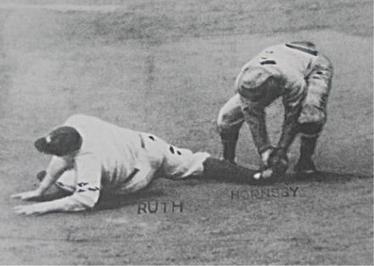
One day after Babe Ruth’s mythical “Called Shot” home run off Cubs pitcher Charlie Root (who vehemently denied the gesture ever happened, although this still shot shows Root’s back was turned during the alleged “call” so he never actually saw it,) the Bronx Bombers would bash out 19 hits en route to the drubbing of the home team. The title would be the Yankees’ first of five championships in the decade, after earning three in the 1920’s, kicking in full gear a long streak of regular World Series appearances (52) and titles (27,) both MLB records to this day.

Sources: http://www.nationalpastime.com

http://www.baseball-reference.com

Photo Credit: